

 About Us
https://mcp.prowler.com/mcp so the Cursor agent can query findings, inspect security checks, and manage your Prowler providers while you work.
Cursor supports remote MCP servers over HTTP natively, so no bridge or local installation is required.
Prerequisites
- Cursor installed and authenticated. See the official install guide.
- A Prowler Cloud account. The free tier is enough to start. Sign up at cloud.prowler.com.
Step 1: Get Your Prowler API Key
Create an API key in Prowler Cloud and copy it. The key begins withpk_ and is shown only once. Check the API Keys guide for details.
Step 2: Add the Prowler MCP Server
Cursor reads MCP servers from anmcp.json file. Choose the scope that fits your use case:
Both files are merged. If the same server name appears in both, the project-level entry takes priority.
For Prowler, the global scope is usually the right choice — your findings are not tied to a single repository, and it keeps the API key out of any project directory that might be committed.
1
Open the MCP settings
From Agent Window open Customize in the Cursor sidebar, then select the MCP section.On earlier versions, press
Cmd + Shift + J (macOS) or Ctrl + Shift + J (Windows/Linux) to open Cursor Settings, then click Tools & MCP in the sidebar.2
Add a new MCP server
Click New MCP Server (or Add Custom MCP). Cursor opens 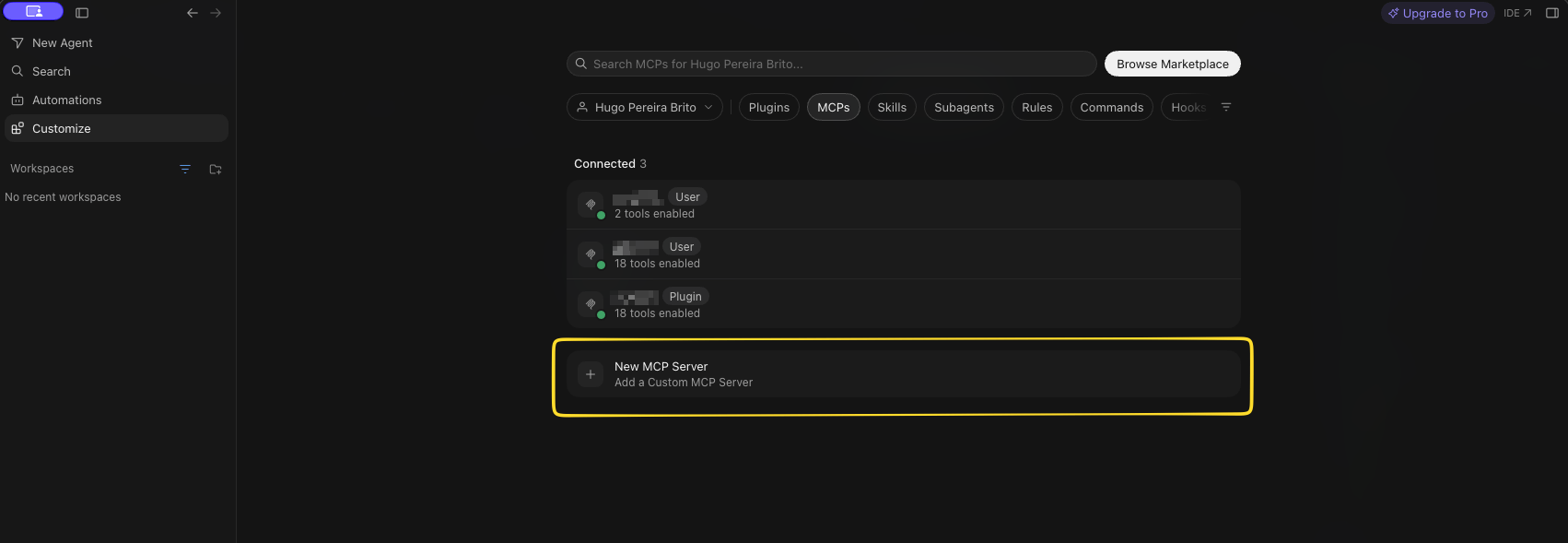
mcp.json in the editor.3
Add the Prowler configuration
Paste the following, replacing the placeholder with your API key:Save the file. Cursor picks up the change and connects to the server.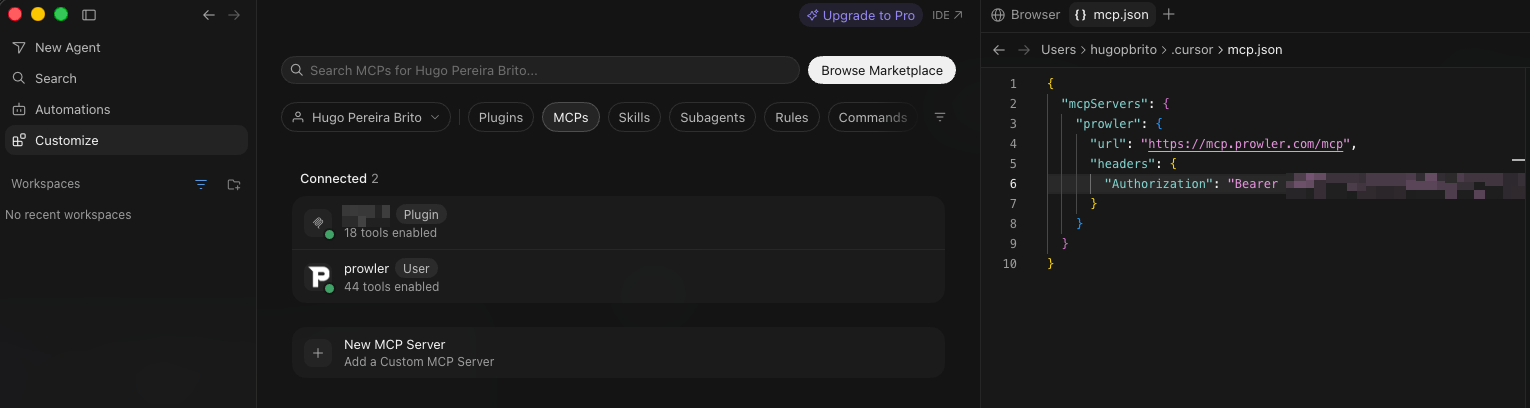
Local server: Replace the URL with your own HTTP endpoint. Everything else stays the same.
Keeping the API Key Out of the File
Cursor resolves variables in thecommand, args, env, url, and headers fields, so you can reference an environment variable instead of writing the key into mcp.json:
~/.zshrc, ~/.bashrc, or equivalent):
The syntax is
${env:NAME}, not a bare ${NAME}. Restart Cursor after changing your shell profile so it inherits the new value..cursor/mcp.json, since that file may be committed to version control.
Step 3: Verify the Connection
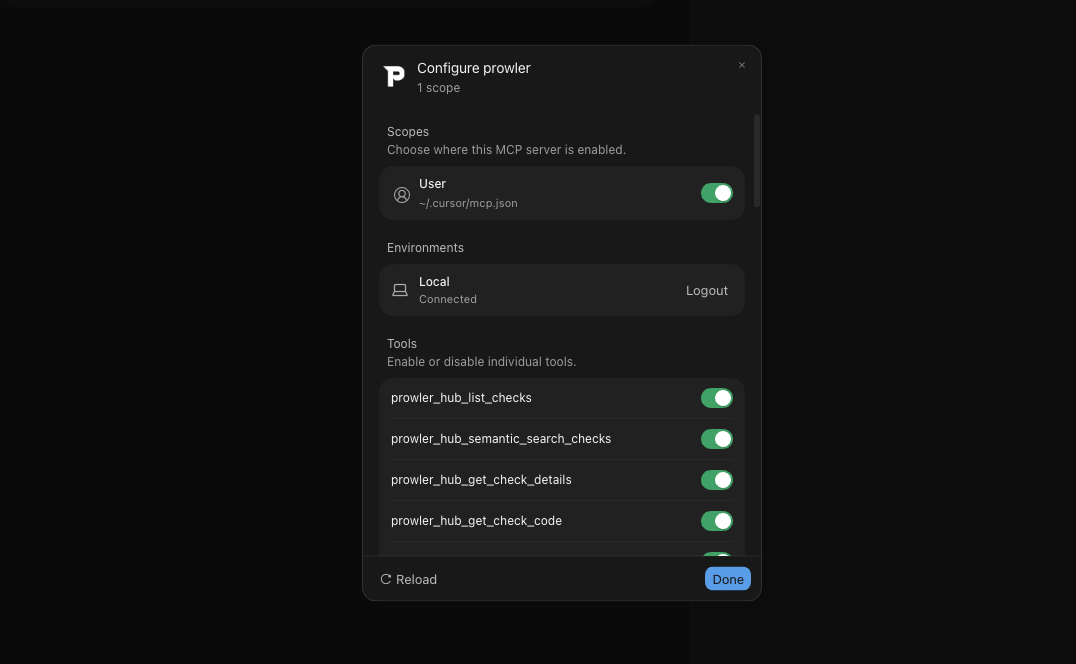
Return to the MCP settings. Theprowler server should be listed as enabled, with the Prowler tools shown beneath it.
Step 4: Start Using Prowler MCP
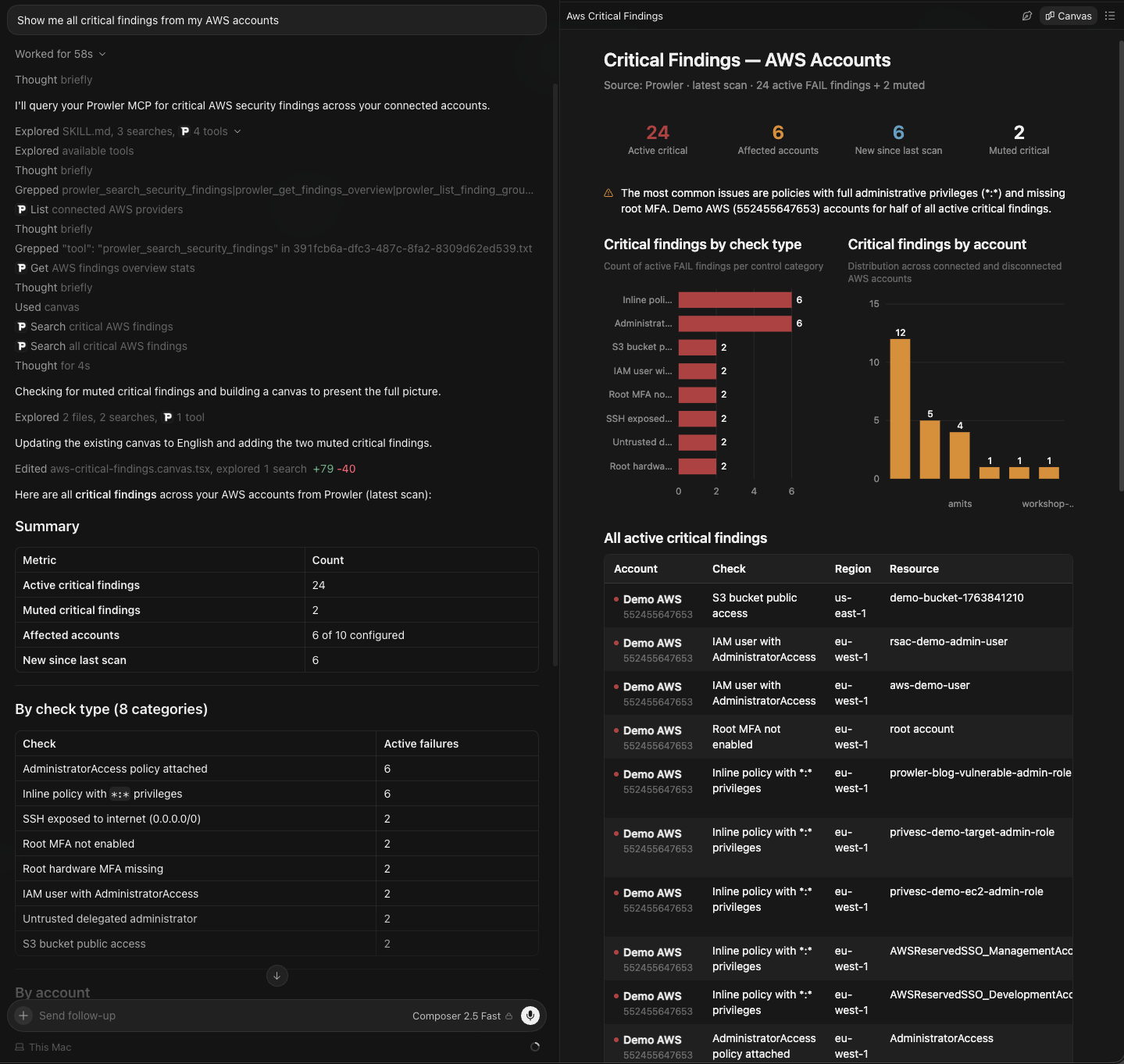
Open the chat panel and ask questions that use the Prowler tools:- “Show me all critical findings from my AWS accounts”
- “What does the S3 bucket public access check do?”
- “Which of my providers failed the most CIS checks in the last scan?”
Troubleshooting
Server Does Not Connect
- Check that
mcp.jsonis valid JSON. A trailing comma or missing brace prevents the whole file from loading. - Open MCP Logs in the Output panel for the specific error.
- Confirm the URL is exactly
https://mcp.prowler.com/mcp.
Authentication Fails With 401
- Verify the header value includes the
Bearerprefix:"Bearer pk_...", not just the key. - Confirm the key has not been revoked in Prowler Cloud.
- If using
${env:PROWLER_API_KEY}, check the variable is set in the environment Cursor inherits. Restart Cursor after editing your shell profile — a value exported only in an already-open terminal will not reach the app.
The Entire mcp.json Is Ignored
Remove any "type": "streamable-http" field. One such entry causes the Cursor CLI to drop every server in the file silently.
Some Prowler Tools Are Missing
Cursor limits how many tools it exposes to the agent at once. With several MCP servers enabled you may exceed it, and some tools become unavailable. Disable servers you are not using, or turn off individual tools from the chat panel’s tools list.Next Steps
Tools Reference
Explore all available tools and capabilities
All MCP Clients
Configuration reference for every supported client
Getting Help
- Search for existing GitHub issues
- Ask for help in our Slack community
- Report a new issue on GitHub