

 About Us
October 15, 2026
🤖 Azure — AI Services Coverage
A new Azure AI Services service audits the Azure AI and Azure OpenAI accounts of each subscription, with nine checks across network exposure, authentication, encryption, identity, logging and content safety, all contributed by @rajeshnadiminti. Thank you!aiservices_account_public_network_access_disabled,aiservices_account_network_acls_default_action_deny,aiservices_account_uses_private_endpointandaiservices_account_outbound_network_restrictedcover how the account can be reached and what it can reach.aiservices_account_local_auth_disabledandaiservices_account_managed_identity_enabledcover key-based access and the account’s own identity.aiservices_account_encrypted_with_cmkandaiservices_account_diagnostic_logging_enabledcover customer-managed key encryption and diagnostic logs.aiservices_deployment_content_filter_prompt_shield_enabledverifies that model deployments have Prompt Shields enabled in their content filter.
🪪 Microsoft 365 — New Entra ID Checks
Five new Entra ID checks, all contributed by @kinomakino. Thank you!entra_cross_tenant_access_default_outbound_restrictedverifies that the default cross-tenant access policy does not let every user reach every external application through B2B collaboration or B2B direct connect.entra_policy_admin_self_service_password_reset_disabledverifies that Self-Service Password Reset is disabled for administrators.entra_policy_msol_powershell_blockedverifies that the tenant authorization policy blocks the legacy MSOnline PowerShell module.entra_app_registration_redirect_uris_secureflags app registrations with HTTP, wildcard, malformed orazurewebsites.netredirect URIs.entra_dynamic_group_member_of_rule_not_usedflags dynamic groups whose membership rule uses thememberOfoperator, which Microsoft retires on November 3, 2026.
☁️ OCI — Connect Tenancies Outside us-ashburn-1
OCI API key credentials now take a home region, and the credentials form in Prowler App requires it. Identity calls that validate the credentials and discover the subscribed regions used to go tous-ashburn-1 regardless of the tenancy, so a tenancy not subscribed to that region could not connect. The home region is only used for that bootstrap; scans still audit every subscribed region.Read more in the Getting Started with OCI documentation.🛠️ Improvements and Fixes
- AWS: Organizations metadata is fetched from the partition of the audited account, using the region that answered the STS bootstrap, instead of the commercial
us-east-1endpoint, which timed out in GovCloud. - API Gunicorn workers are recycled after 10,000 requests, plus up to 1,000 of jitter, to cap memory growth. Both values are configurable with
GUNICORN_MAX_REQUESTSandGUNICORN_MAX_REQUESTS_JITTER. - The first-login redirect to the Add Provider wizard is retried on the next load when the navigation was cut short, instead of being written off after a single attempt.
- The AWS connect step offers to invite a teammate when the user cannot access the account credentials.
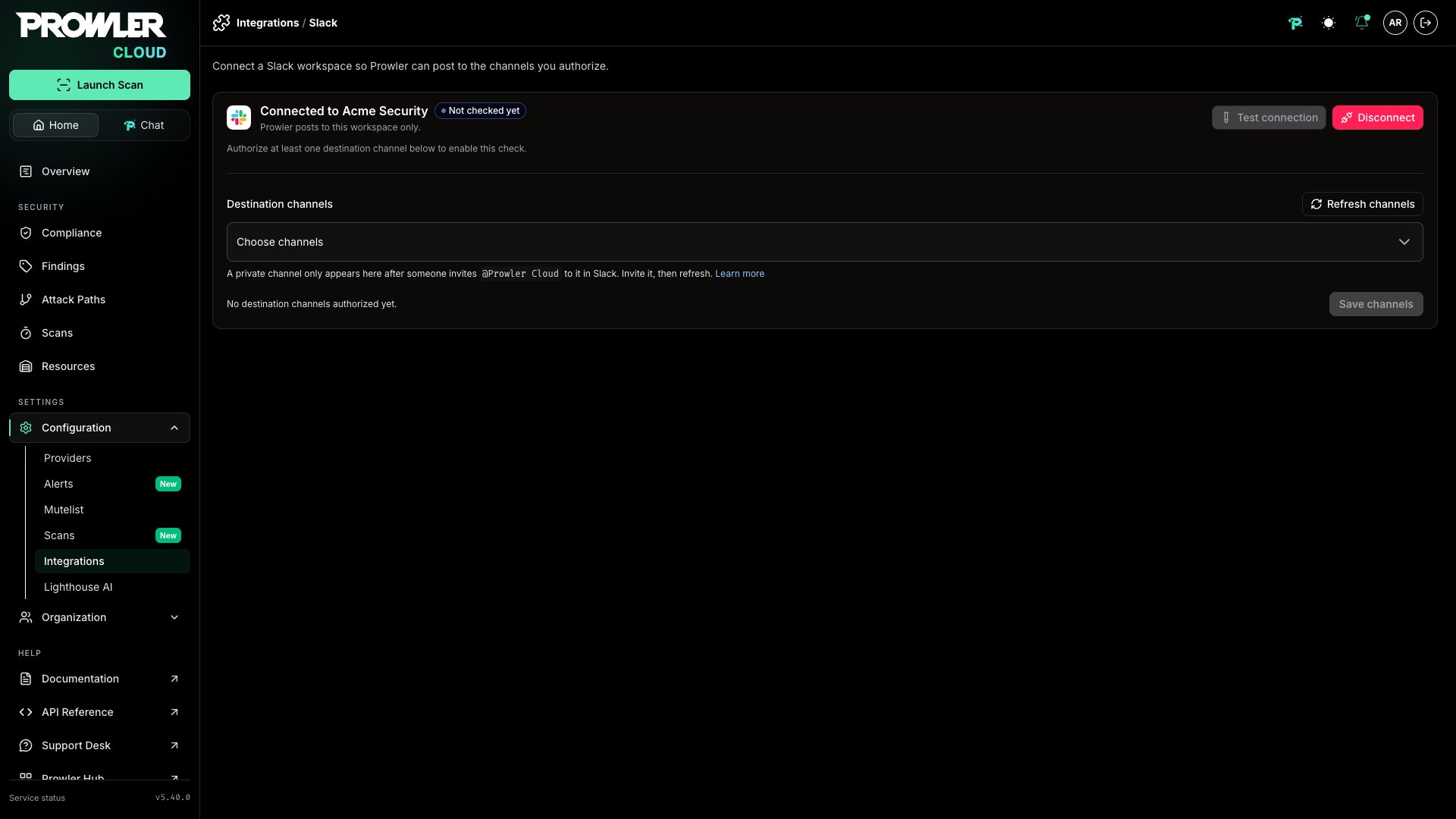
- Prowler Cloud: the Slack channel picker reads the channels the Prowler app is in before the public ones, so invited private channels show up in large workspaces, and the partial list message tells the user to invite the app to a missing channel.
🔐 Security Updates
- Kubernetes kubeconfigs accept only inline credentials and known cluster fields. File-path fields, command-based authentication,
auth-providerdirectives, proxy URLs and unknown keys are rejected by the API and the credentials form, and stored kubeconfigs are re-validated before each scan and connection test. - IaC repository URLs that resolve to loopback, private or otherwise non-public hosts are rejected before the connection test and the scan clone, including every destination a redirect points to.
- CSV outputs prefix cells starting with
=,+,-,@, tab or carriage return with a single quote so spreadsheet applications treat them as text, and the HTML report escapes the compliance column. GET /api/v1/users/{id}no longer exposes another user’s memberships, roles or tenant names from tenants other than the one in the request token.- API error reports sent to Sentry no longer include user identity, IP addresses, cookies, headers or request bodies.
- PowerShell upgraded to 7.5.12 in the SDK and API container images, bundling .NET runtime 9.0.21.
- Python base images upgraded to 3.12.15 in the SDK and API and to 3.13.16 in the MCP Server, and Trivy to 0.75.0, patching CVE-2026-19445, CVE-2026-19553 and the grpc-go and x/crypto CVEs bundled in Trivy.
djangoupgraded to 5.2.17 in the API, patching CVE-2026-15307.pyjwtupgraded to 2.14.0 in the SDK, the API and the MCP Server, patching GHSA-ffc3-869f-jxw9.pymongoupgraded to 4.18.2 andurllib3to 2.8.0 in the SDK and the API, patching CVE-2026-96748, CVE-2026-96749, CVE-2026-97687 and CVE-2026-97689.dulwichupgraded to 1.2.9 in the SDK and the API, patching GHSA-5fqc-mrg8-w798, GHSA-8mcx-5rqc-vhmf, GHSA-8w8g-wq8h-fq33 and GHSA-cm62-gvxx-vmxx.nextupgraded to 16.3.8 in the UI, patching a remote code execution innext/og(GHSA-vcvr-r3jv-pc5j) and a server-side request forgery in Image Optimization (GHSA-cjq9-62q9-8jv4).sharpupgraded to 0.35.5 andproxy-addrto 2.0.8 in the UI, patching GHSA-wq5f-xc86-pv6w and GHSA-jqcg-44mw-7w3h.
🙌 External Contributors
Thank you to our community contributors for this release!- @rajeshnadiminti: Azure AI Services service and its checks (#12925, #12926, #12997)
- @kinomakino: Microsoft 365
entra_cross_tenant_access_default_outbound_restricted(#12991),entra_policy_admin_self_service_password_reset_disabled(#12990),entra_policy_msol_powershell_blocked(#13004),entra_app_registration_redirect_uris_secure(#12993) andentra_dynamic_group_member_of_rule_not_used(#13003) checks
September 29, 2026
🔁 Findings — Re-check a Resource with a Partial Scan
This feature is available exclusively in Prowler Cloud and Prowler Private Cloud with a subscription.
FAIL. Partial scans do not change overviews or compliance until the next full scan and produce no report files, so the Scans table marks them as Partial, offers no report download for them, and the per-scan Compliance selector leaves them out.Partial scans can also be launched outside the Findings page:- API:
POST /api/v1/scansaccepts up to 10 resources inresource_uids, and scans exposeis_partialwith afilter[is_partial]filter. - MCP Server:
prowler_trigger_scantakes aresource_uidsargument, andprowler_list_scansandprowler_get_scanreturnis_partial, with anis_partialfilter onprowler_list_scans. - Lighthouse AI: can launch a partial scan to re-check specific resources, such as confirming a remediation.
☁️ AWS — Connect an Account in One Step
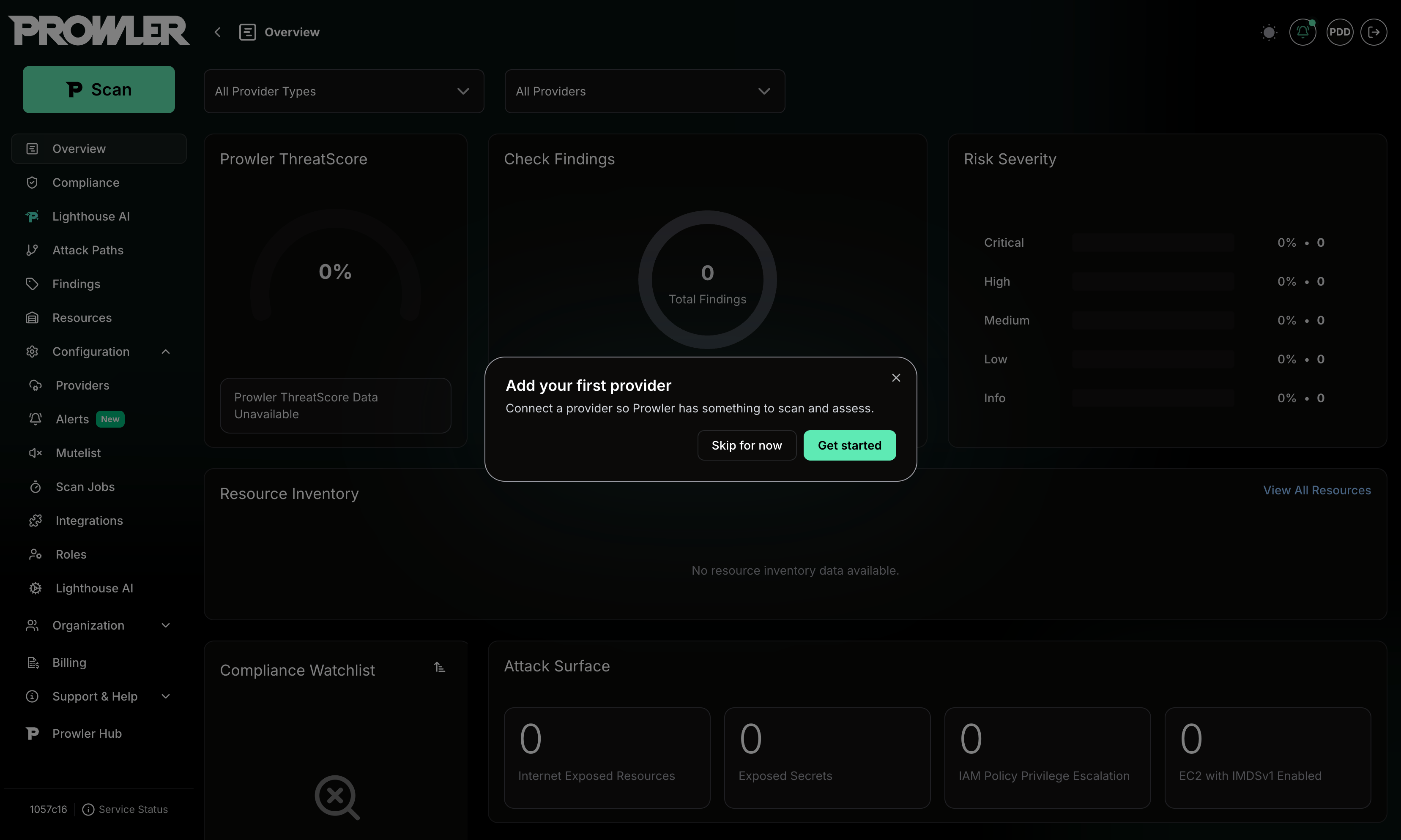
The Add Provider wizard connects an AWS account in a single step. The account ID is read from the role ARN (or typed when using static access keys), the role is assumed with Prowler’s own credentials, and the account, its credentials and the connection test are handled by one submit. A confirmed connection goes straight to the launch step. A refused connection stays on the form with the reason the API returned, so the fields can be fixed and retried without registering the account twice.New tenants without providers now land on this wizard on their first sign-in instead of a welcome modal, and the sidebar action reads Add Provider until the first provider is connected.Read more in the Getting Started with AWS documentation.🔌 Connection Tests No Longer Give Up Early
The provider connection test no longer reportsMax retries exceeded for checks that take longer than 30 seconds, such as networks where some AWS endpoints are unreachable. The UI now waits for the full time limit of the backend task, and if that is still exhausted it shows the provider’s current connection state instead of a failure.On the SDK side, STS calls after a role assumption reuse the region that answered, so an unreachable partition region is waited on once instead of twice. The new PROWLER_AWS_BOTO3_RETRIES_MAX_ATTEMPTS environment variable sets the Boto3 retries for deployments that build the AWS provider without CLI flags, next to the existing timeout variables; 0 disables retries.Read more in the Boto3 configuration documentation.🗄️ Self-Hosted — S3-Compatible Storage and Air-Gapped Deployments
DJANGO_OUTPUT_S3_AWS_ENDPOINT_URLpoints scan output uploads and downloads at S3-compatible object storage such as MinIO. Previously the only way to reach it was exporting process-wide AWS environment variables, which also hijacked unrelated AWS API calls such as role assumption for AWS providers.- Report downloads from a bucket with default SSE-KMS encryption no longer fail with
InvalidArgument: whenDJANGO_OUTPUT_S3_AWS_DEFAULT_REGIONis set, download URLs are signed with Signature Version 4 for that region. - Icons ship in the UI bundle instead of being fetched from
api.iconify.design, so pages render correctly without internet access. - Celery worker fatal errors are logged instead of silenced, and every long-running service in
docker-compose.ymlrestarts automatically after an unexpected crash.
📊 Consistent Latest Scan Across Endpoints
Every endpoint now resolves a provider’s latest completed scan the same way, so overlapping scans no longer make findings, compliance and mute rules read from different scans. Providers whose latest completed scan has nocompleted_at timestamp are no longer missing from those endpoints, and resources no longer keep a stale failed findings count when a scoped or imported scan completes after a full scan.🛠️ Prowler App Fixes
- API key authentication no longer locks the key row on every request, so a heavily used key no longer serializes all its requests;
last_used_atis updated at most once per minute. POST /api/v1/scansreturns the new scan ID intask_argsagain.- Provider deletion no longer fails when the provider has Attack Paths scans recorded on a sink that is no longer configured, such as Neptune after moving back to Neo4j.
- A periodic sweep drops orphaned Attack Paths temporary Neo4j databases left behind when a worker or Neo4j crashes mid-scan.
- Prowler Cloud: imported findings no longer stay stuck in
pendingwhen the ingestion worker picks up the job before it is committed, and a failed enqueue marks the ingestion as failed. - Prowler Cloud: the Lighthouse AI connection check reports a network failure as one, naming the endpoint it could not reach, instead of hitting a time limit that looked the same as a bad key.
- Prowler Cloud: the finding groups endpoints no longer query Manual Pass triages once per finding, and skip that overlay for tenants with no active Manual Pass.
- The Findings page renders a skeleton at once and streams the table before the filters, and the Finding Group options load when the dropdown opens.
- Mute rule creation errors show the API error message instead of the raw response body.
- The sidebar no longer throws a hydration error on full page loads for users who last used the chat mode.
🔐 Security Updates
DELETE /api/v1/tasks/{id}requires the permission of the operation that queued the task and rejects provider deletions, andGET /api/v1/taskshides tasks of providers outside the role’s visibility.- The UI E2E workflow receives its AWS credentials through environment variables instead of template expansion.
September 21, 2026
🏛️ Compliance — FedRAMP 20x Consolidated Rules 2026
The FedRAMP 20x Phase One pilot frameworks (fedramp_20x_ksi_low_aws, fedramp_20x_ksi_low_azure and fedramp_20x_ksi_low_gcp) are replaced by two universal frameworks built from the FedRAMP Consolidated Rules for 2026, each covering AWS, Azure, GCP, Kubernetes and Microsoft 365 from a single definition:- FedRAMP 20x KSI (
fedramp_20x_ksi_2026): the 46 Key Security Indicators across 10 themes. There is one indicator catalog for every class instead of a separate Low fork; each indicator carries its class applicability and NIST SP 800-53 controls. - FedRAMP 20x Class C FRR (
fedramp_20x_frr_class_c_2026): the 158 FedRAMP Rules of the Class C ruleset that bind cloud service providers. Most are program obligations (reports, notifications, certification package) and stay manual; checks are mapped only where they evidence part of the rule text. Configurable checks carry configuration requirements, so a relaxedaudit_configcannot turn a requirement green.
fedramp_20x_ksi_2026. In Prowler App, both frameworks show the per-provider breakdown in the cross-provider compliance view and can be downloaded as OCSF.Read more in the Compliance documentation.🔎 AWS — Inspector Coverage, CISA KEV and FIPS Checks
Seven new AWS checks back the vulnerability detection and cryptography rules of FedRAMP 20x Class C:inspector2_coverage_scan_status_activeandinspector2_coverage_recently_scannedreport resources Amazon Inspector is not scanning, or last scanned more thaninspector2_max_days_since_last_scandays ago (default 3).inspector2_active_findings_no_known_exploited_vulnerabilitiesandinspector2_active_findings_kev_within_due_datereport active findings whose CVE is in the CISA Known Exploited Vulnerabilities catalog, and those still open past the CISA due date. The KEV data comes from Inspector itself throughinspector2:BatchGetFindingDetails, so no external feed is needed.inspector2_active_findings_within_max_agereports active findings first observed more thaninspector2_active_finding_max_age_daysdays ago (default 192).elbv2_listener_fips_tls_enabledandtransfer_server_fips_security_policy_enabledreport HTTPS/TLS load balancer listeners and Transfer Family servers without a FIPS security policy.
inspector2:BatchGetFindingDetails is not part of SecurityAudit, so it is now included in the Prowler additions policy and the CloudFormation scan role. Without it, the KEV checks report MANUAL naming the missing permission instead of a false FAIL.Explore all AWS checks at Prowler Hub.☁️ AWS — Partition Bootstrap Failover
WhenPROWLER_AWS_PARTITION is set, the bootstrap STS calls (validating credentials, assuming a role and getting an MFA session token) now try up to two more regions of the partition if the first one cannot be reached. A GovCloud host whose configured region belongs to another partition was still sent to us-gov-east-1, and on a network that routes only to us-gov-west-1 the connection check and the scan failed on perfectly valid credentials. Only connection errors and timeouts move on to the next region; credential errors are reported from the first one as before. Later STS calls reuse the region that answered, and nothing changes when PROWLER_AWS_PARTITION is unset.Read more in the AWS Regions and Partitions documentation.🌐 Azure — Sovereign Cloud Endpoints for Defender and Key Vault
Defender security contacts and Key Vault key rotation policies now use the endpoints of the cloud selected with--azure-region instead of the hardcoded management.azure.com and vault.azure.net hosts, so both work on AzureUSGovernment and AzureChinaCloud. Key Vault clients are built from the vault URI that Azure returns for each vault.Read more in the Azure non-default cloud documentation.✉️ Invitations — Expired Invitations No Longer Block Re-Invites
A pending invitation past its expiry date is now reported as expired, and inviting the same email again marks it as expired and creates the new invitation instead of returning a generic error. The Invitations table disables Edit and Revoke on expired and revoked invitations, andfilter[state__in] on the invitations endpoint no longer returns a server error.In Prowler Cloud, new organizations are offered an Invite your team step once the first provider is connected, and Prowler Private Cloud deployments can set UI_SELF_REGISTRATION_ENABLED=false to make sign-up invitation-only.Read more in the Invitations documentation.📄 Reports — Downloads on Self-Hosted Storage
Report downloads no longer depend on the storage host being the same inside and outside the container network.DJANGO_OUTPUT_S3_AWS_PUBLIC_ENDPOINT_URL signs the download URL against a browser-reachable host, so a deployment whose object storage answers only on an internal address serves the file instead of a link the browser cannot open. Leaving DJANGO_OUTPUT_S3_AWS_DEFAULT_REGION unset, common on S3-compatible storage with no meaningful region, no longer makes the download fail with a server error.🔍 Checks
- Huawei Cloud: new
smn_topic_subscriptionscheck reports SMN topics without any subscription. - Cloudflare: the API token links in the provider wizard request the SSL and Certificates, Bot Management and Zone WAF read permissions the checks need, so a token created from the wizard no longer produces failures on permissions it was never granted.
- Microsoft 365: five Defender malware, anti-phishing and inbound anti-spam checks no longer fail with
KeyErroron tenants that use the Standard or Strict preset security policies, which dropped every finding of those checks. Preset policies are covered bydefender_strict_preset_security_policy_enabled. - Google Workspace:
security_2sv_enforcedreports domain-wide 2-Step Verification failures asFAILeven when every failing setting is overridden for a group or organizational unit.
🔐 Security Updates
libsqlite3-0,gzip,perl-base,libssh2-1t64andlibpcre2-8-0upgraded in the SDK and API container images, patching high-severity Debian CVEs.- PowerShell upgraded to 7.5.11 in the SDK and API container images, bundling .NET runtime 9.0.20 and patching CVE-2026-62901.
anyioupgraded to 4.14.2 in the SDK, the API and the MCP Server, patching CVE-2026-63374.
September 11, 2026
☁️ AWS — ISO Partitions
Prowler now resolves regions and services for the AWS ISO partitions (aws-iso, aws-iso-b, aws-iso-e and aws-iso-f) the same way it does for the commercial, China, European Sovereign Cloud and GovCloud partitions. The region matrix is filled from the endpoint metadata bundled with botocore, which needs no credentials or network access, so it covers partitions that are air-gapped from the internet. Scanning them no longer requires a hand-edited aws_regions_by_service.json: ISO regions such as us-isob-east-1 are accepted by --region and --excluded-region.Deployments that declare PROWLER_AWS_PARTITION also keep their bootstrap STS calls in the configured region when it belongs to that partition. An install in us-gov-west-1 that reaches AWS only through its own VPC endpoints is no longer sent to us-gov-east-1, where the connection check and the scan used to time out.Read more in the AWS Regions and Partitions documentation.⏱️ AWS — Configurable Timeouts for Restricted Networks
Scans from networks with restricted egress (VPC endpoints for only some services, GovCloud or private deployments) could take hours: Boto3 waits 60 seconds to connect by default and retries connection errors, so every service without a reachable endpoint cost up to four 60-second attempts in every region. Prowler now lowers the default connect timeout to 10 seconds, keeps the read timeout at 60 seconds, and exposes both through--aws-connect-timeout and --aws-read-timeout, or through the PROWLER_AWS_BOTO3_CONNECT_TIMEOUT and PROWLER_AWS_BOTO3_READ_TIMEOUT environment variables for deployments without a CLI. --aws-retries-max-attempts 0 now disables retries instead of silently falling back to three, leaving a single attempt per call.Read more in the Boto3 configuration documentation.🐳 Image Provider — Reusable Vulnerability Database
The Image provider now honorsTRIVY_CACHE_DIR. When the variable names a directory, Trivy keeps its vulnerability database there and Prowler leaves the directory in place after the scan, so the database is downloaded once instead of on every scan. Hosts without internet access can now scan images by pointing TRIVY_CACHE_DIR at a pre-populated database and setting TRIVY_SKIP_DB_UPDATE=true. Without the variable, the temporary cache is created and removed as before.Read more in the Image provider documentation.🎫 Jira Integration — Faster Connection Test
Testing a Jira integration no longer reports a false failure on accounts with many projects. The connection test fetched the issue types of every project one request at a time, which could outlast the wait in the UI even when the check was about to succeed. Issue types are now fetched concurrently, a project whose issue types the integration user cannot see is no longer logged as an error, and the Integrations page keeps following the connection test instead of giving up after about a minute.Read more in the Jira integration documentation.📚 Compliance — Catalog Integrity Fixes
A new integrity test runs over every compliance framework, asserting unique requirement IDs, no check listed twice within a requirement, and that every referenced check exists for its provider. The fixes it drove span 42 frameworks across AWS, Azure, GCP, GitHub, Kubernetes and Microsoft 365:- Duplicate requirement IDs: identical copies are removed, and distinct requirements that shared an ID get their own, such as
1.10in CIS AWS 5.0 andrc_rp_1for RC.RP-1 in NIST CSF 1.1. In Prowler ThreatScore for Azure, SQL auditing retention moves from3.2.1to3.2.4, and requirement1.2.1of Prowler ThreatScore for GCP now points toiam_sa_no_user_managed_keys. - Stale check references: checks that no longer exist are replaced with their current name when there is a direct equivalent, or removed so the requirement reports as manual. Most of these were in the FedRAMP 20x KSI frameworks.
uuid7 IDs grouped by framework and requirement.Read more in the Compliance documentation.🔍 Checks
rolesanywhere_profile_restricts_session_permissions, iam_role_service_trust_restricts_source_to_account and codebuild_project_uses_allowed_github_organizations no longer crash with TypeError when the scanning role is denied iam:ListRoles, which dropped every finding of those checks for the account. Without the role inventory, an enabled IAM Roles Anywhere profile without session scoping reports MANUAL, and CodeBuild projects whose service role cannot be resolved are skipped.Explore all AWS checks at Prowler Hub.🔐 Security Updates
nextupgraded to 16.3.3 in the UI, patching unauthenticated remote code execution through AVIF image optimization (GHSA-2xp9-vwfh-vxw4) and on Windows-hosted servers (GHSA-p293-qw3h-jr36).sharpupgraded to 0.35.4 in the UI, patching libheif image-decoding vulnerabilities (GHSA-rgj7-g3m4-5g8c).nanoid,js-yamlandpostcss, plus eleven transitive UI dependencies, upgraded to patched versions, resolving 40 npm audit advisories (21 high, 15 moderate, 4 low).libuuidupgraded to 2.41.6-r1 in the MCP Server image, patching CVE-2026-53612, CVE-2026-53613, CVE-2026-53614, CVE-2026-76642, CVE-2026-78408 and CVE-2026-78410.
September 2, 2026
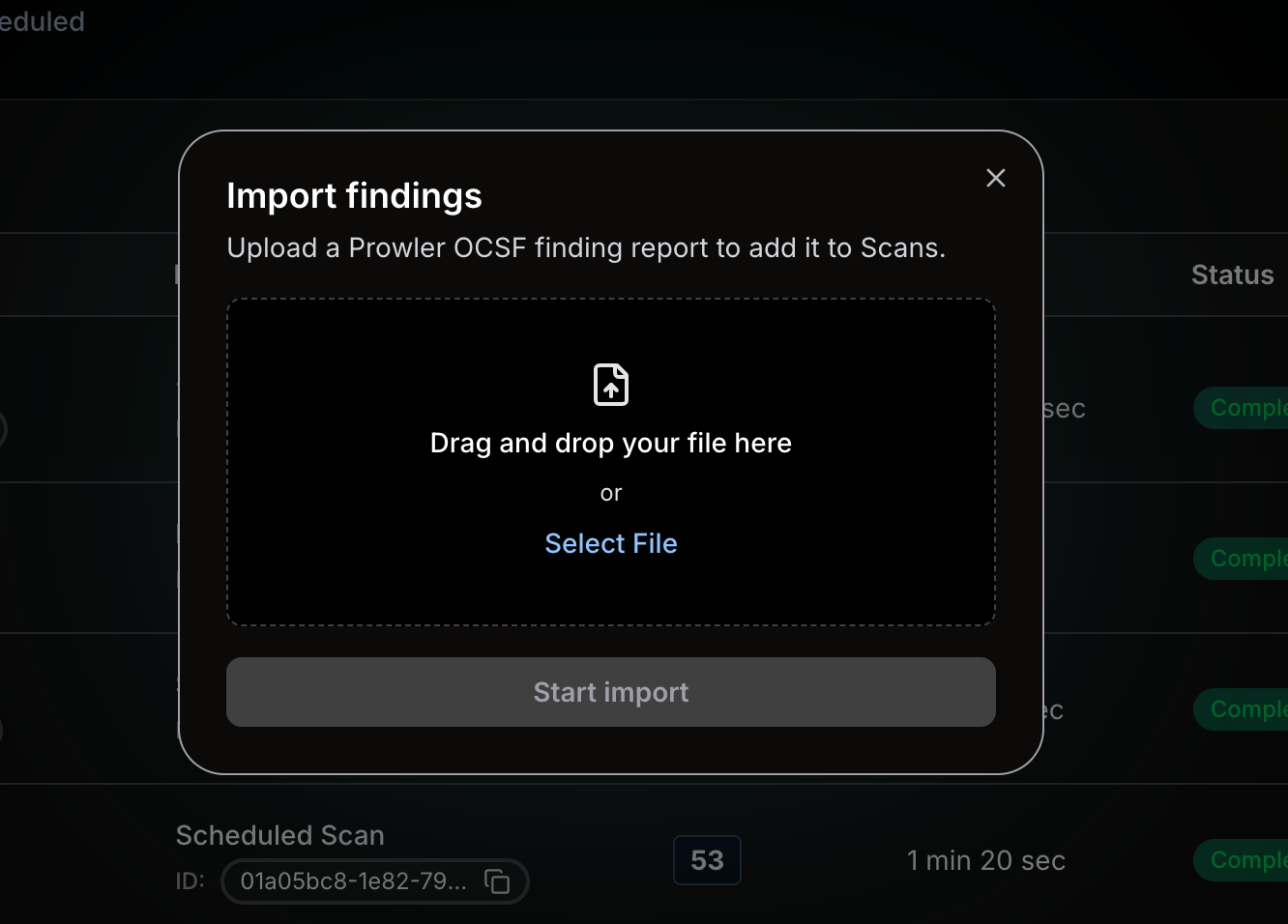
📥 Scans — Import Findings from the Browser
This feature is available exclusively in Prowler Cloud and Prowler Private Cloud with a subscription.
.ocsf.json report by drag-and-drop or file picker, hands it to the ingestion API and tracks the job to completion, reporting how many records were processed and how many were invalid. Files that are not a .ocsf.json report, or are empty, are refused before any upload starts, and a rejected upload or a failed status poll can be retried in place. The dialog is available to roles holding the Manage Ingestions permission.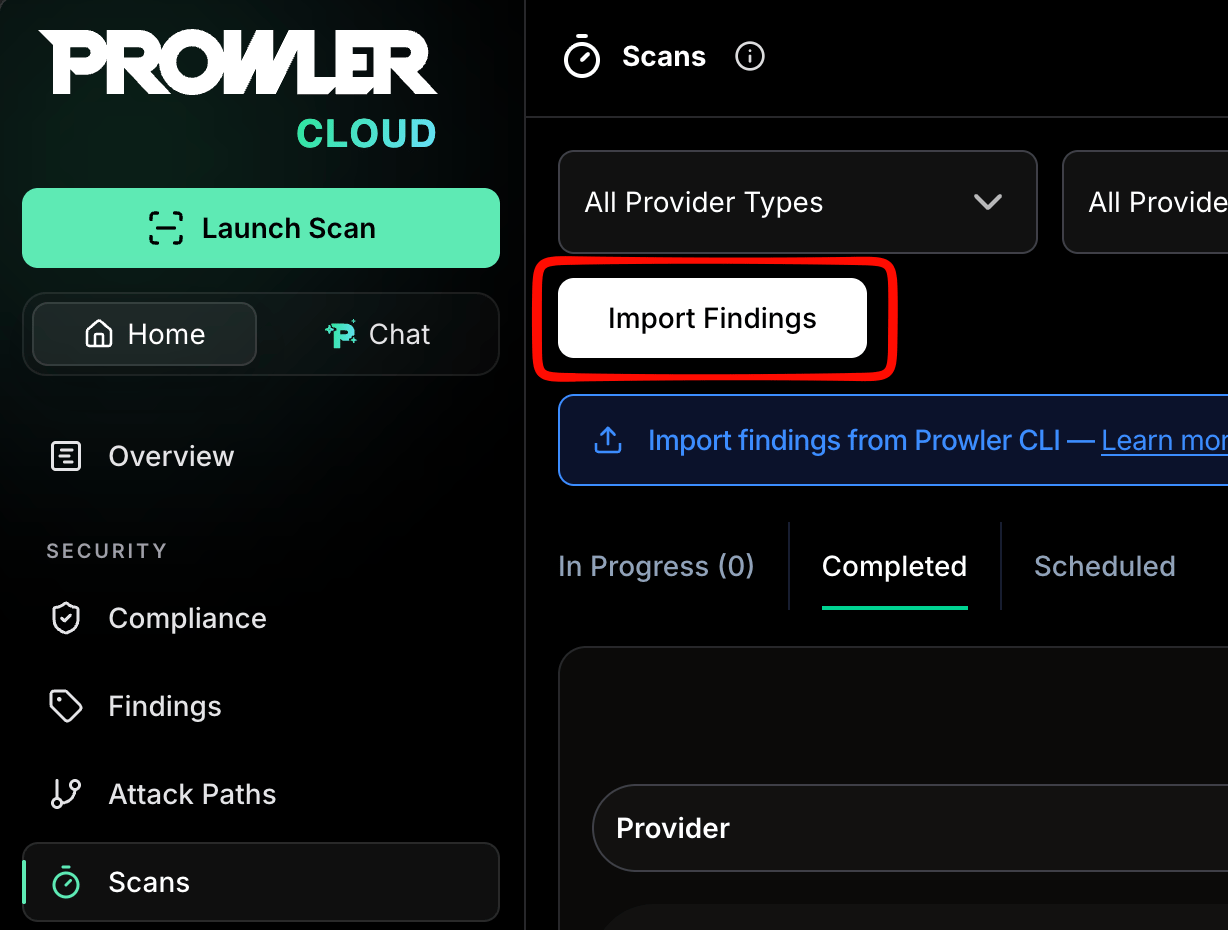
🎫 Jira Integration — Finding Reference in Every Issue
Every Jira issue created from a finding now carries a stable reference back to it. Issues are labeledprowler, prowler-<provider>, prowler-<severity>, prowler-<check-id> and prowler-finding-<finding-uid>, so they can be filtered, searched with JQL or matched by automation; labels are sanitized to Jira’s limits so a long or unusual value never blocks issue creation. The issue also links back to the finding in Prowler, filtered by its UID so the link keeps working after later scans, and names the Prowler organization that sent it. Prowler Cloud always includes the link; Prowler Local Server enables it by setting DJANGO_UI_BASE_URL in the API environment.Read more in the Jira integration documentation.📚 Compliance — CIS Google Workspace Foundations Benchmark v1.4.0
Prowler now ships the CIS Google Workspace Foundations Benchmark v1.4.0. Alongside the new framework, the Google Workspace checks mapped to CIS were reworked to evaluate the benchmark’s full audit procedure instead of a single condition, so Gmail spoofing actions, 2-Step Verification, password expiration and alert severity left on Google’s defaults no longer pass. Expect newFAIL findings on domains that rely on those defaults. Three accuracy fixes also land:security_2sv_enforcedandsecurity_2sv_hardware_keys_adminsreportMANUALinstead of judging domain-wide values that a group or a sub-organizational unit overrides; a domain-wide failure is still reported as such, with the override noted.rules_*_alert_configuredno longer passes a rule whose delivery to the alert center is disabled.security_password_policy_strongno longer fails a domain that never touched the password strength setting, since Google enforces strong passwords by default.
security_login_challenges_configured was unmapped from CIS Google Workspace requirement 4.1.4.1 (Post-SSO verification) and security_2sv_enforced from CISA SCuBA GWS.COMMONCONTROLS.1.1 (phishing-resistant MFA), because neither check can prove what those requirements ask for.Read more in the Compliance documentation.🔍 Checks
Ten new AWS checks land in this release, eight of them contributed by @tamg-aws. Thank you!Amazon Bedrock AgentCore
iam_policy_passrole_to_bedrock_agentcore_restrictedflags customer-managed IAM policies that allowiam:PassRoleover every role where the passed role can reach Bedrock AgentCore, so any principal holding the policy could run agent code under any role in the account.iam_policy_no_agentcore_workload_access_token_wildcardflags customer-managed IAM policies that allowbedrock-agentcore:GetWorkloadAccessToken,GetWorkloadAccessTokenForJWTorGetWorkloadAccessTokenForUserIdon resources reaching workload identities other than the caller’s own.cloudwatch_log_group_agentcore_data_protection_policy_enabledverifies that Bedrock AgentCore log groups mask sensitive data with a CloudWatch Logs data protection policy. The log group prefixes are configurable throughagentcore_log_group_name_prefixesinconfig.yaml.
Amazon GuardDuty
guardduty_runtime_monitoring_enabledflags detectors without unified Runtime Monitoring, the only feature that covers Amazon EC2 instances and Amazon ECS on AWS Fargate tasks in addition to Amazon EKS.guardduty_ai_protection_enabledflags detectors without AI Protection, which analyzes CloudTrail data events from Amazon Bedrock, Amazon Bedrock AgentCore and Amazon SageMaker AI. A detector that does not report the feature isMANUALrather thanFAIL.
guardduty_eks_runtime_monitoring_enabled no longer reports FAIL for detectors that use unified Runtime Monitoring, which is mutually exclusive with EKS_RUNTIME_MONITORING and already covers Amazon EKS.Amazon ECR and EKS
ecr_registry_enhanced_scanning_enabledverifies that the ECR registry scan type is enhanced (Amazon Inspector, covering programming language packages and continuous rescanning) instead of basic, reportingMANUALwhen the registry scanning configuration cannot be read.eks_cluster_vpc_cni_network_policy_enforcedflags EKS clusters whose Amazon VPC CNI managed add-on does not enable Kubernetes network policy enforcement, reportingMANUALwhere the EKS API cannot show the setting.
AWS IAM, Elastic Beanstalk and MemoryDB
iam_role_service_trust_restricts_source_to_accountflags IAM roles whose trust policy lets an AWS service principal assume the role without confining the request to a specific source account, including trust policies thatiam_role_cross_service_confused_deputy_preventiondoes not evaluate.elasticbeanstalk_environment_no_secrets_in_configurationscans the option settings of every Elastic Beanstalk environment for hardcoded secrets. Thanks to @haneul-24!memorydb_cluster_in_transit_encryption_enabledverifies that MemoryDB clusters have in-transit encryption (TLS) enabled. Thanks to @UTKARSH698!
🐳 Image Provider — On-Premises Registries
Scanning registries that live on private networks is now supported end to end.PROWLER_IMAGE_PROVIDER_ALLOWED_PRIVATE_NETWORKS takes a comma-separated list of IPs and CIDRs the provider may reach, while every other non-public address, including link-local and loopback, stays blocked by the SSRF guard. Authentication negotiation is also more resilient: the provider falls back to Basic when a registry such as Harbor rejects the negotiated bearer token, and switches to a bearer token when the server answers a Basic or anonymous request with a Bearer challenge. --registry-insecure now propagates to Trivy through TRIVY_INSECURE, so images behind self-signed certificates can be pulled and scanned, not just enumerated. The flag now disables certificate validation for the image pull too, so keep it for trusted internal registries only.Registry scans also skip non-image OCI artifacts (Helm charts, cosign signatures, SBOM attestations), no longer abort the whole scan when Trivy fails on a single image, and enumerate repositories in parallel instead of one request at a time.Read more in the Image provider documentation.🛠️ Prowler MCP Server — Tool Failures Reported as Errors
Prowler Local Server tools now report a failure as an MCP tool execution error (isError: true, with the explanation in content) instead of a successful result carrying an {"error": ...} object, which clients and models read as a success. The Prowler Documentation and Prowler Hub tools follow the same rule: prowler_docs_search no longer reports a failed search as zero matches, prowler_docs_get_document no longer reports a failed fetch as a missing page, and prowler_hub_get_check_code and prowler_hub_get_check_fixer now name the provider a check ID actually belongs to instead of reporting it as nonexistent. prowler_get_compliance_framework_state_details also rejects a call that passes both scan_id and provider_id instead of silently ignoring the provider.Read more in the Prowler MCP documentation.🙌 External Contributors
Thank you to our community contributors for this release!- @tamg-aws: GuardDuty unified Runtime Monitoring and AI Protection checks (#12564), EKS VPC CNI network policy check (#12661), ECR enhanced scanning check (#12660), Bedrock AgentCore IAM and service trust checks (#12664), AgentCore log group data protection check (#12662), and fixes to ECR scan frequency (#12560), CloudWatch metric filters (#12561) and SageMaker direct internet access (#12659)
- @haneul-24: AWS
elasticbeanstalk_environment_no_secrets_in_configurationcheck (#12378) - @UTKARSH698: AWS
memorydb_cluster_in_transit_encryption_enabledcheck (#12246) - @ye11oc4t: GitHub repository discovery pagination for unscoped scans (#12460)
August 28, 2026
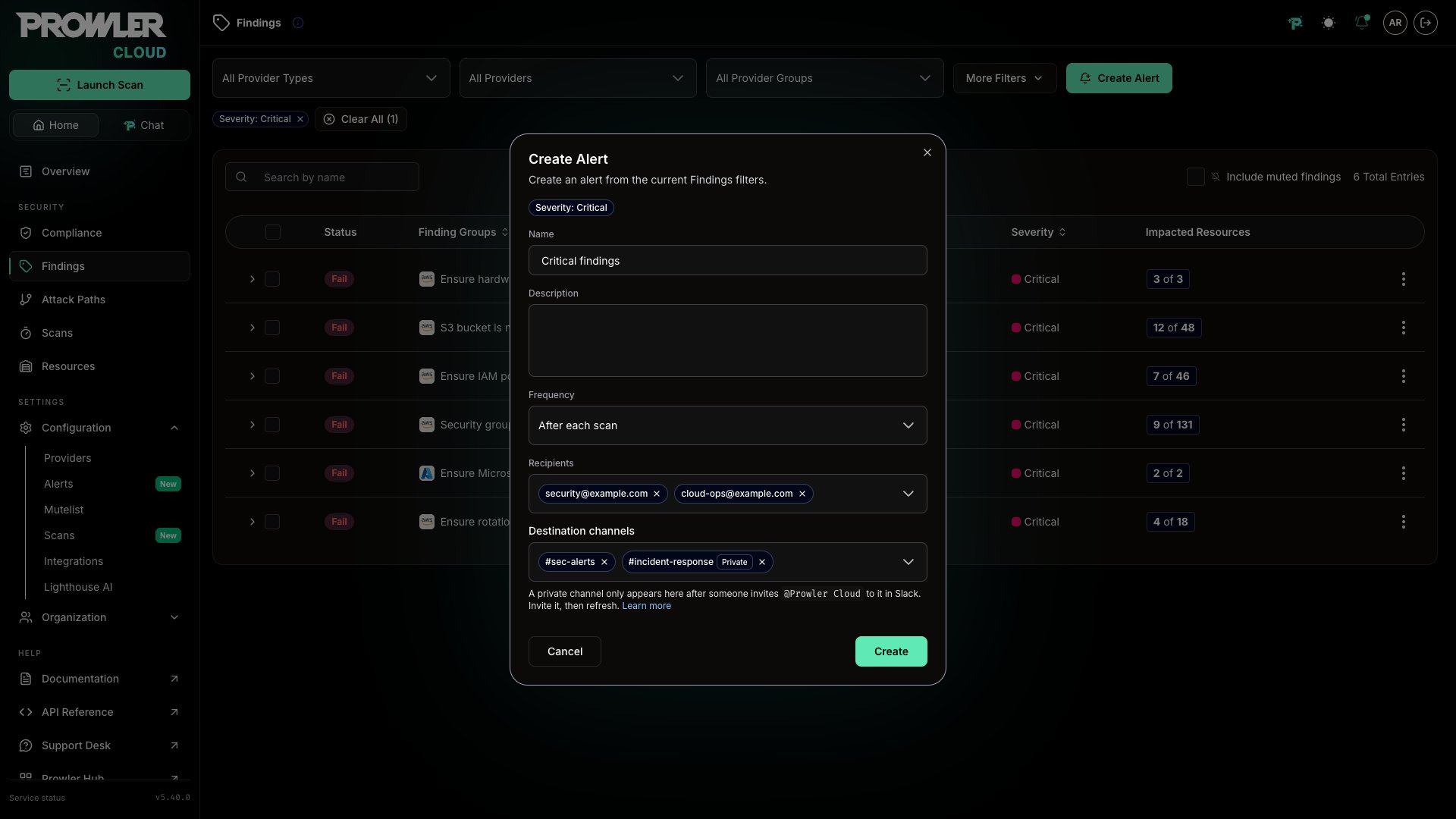
💬 Slack Integration — Alert Channel Destinations
This feature is available exclusively in Prowler Cloud and Prowler Private Cloud with a subscription.
🤖 Lighthouse AI — Answer Feedback
This feature is available exclusively in Prowler Cloud and Prowler Private Cloud with a subscription.
📥 Providers — Imported Findings Indicator
This feature is available exclusively in Prowler Cloud and Prowler Private Cloud with a subscription.

📚 Compliance — NCSC Cyber Essentials 3.3
Cyber Essentials is the UK National Cyber Security Centre (NCSC) scheme certifying the baseline technical controls an organization must implement, and cloud services are explicitly in scope and cannot be excluded from an assessment. Prowler now includes NCSC Cyber Essentials: Requirements for IT Infrastructure v3.3 (April 2026) as a universal framework, with its 28 requirements organized in the five control themes: Firewalls, Secure Configuration, Security Update Management, User Access Control, and Malware Protection.Sixteen requirements map to Azure checks covering the controls the applicant organization owns under the shared responsibility model. The remaining twelve apply to end-user devices, on-premises network appliances, or organizational process, which cloud control-plane evidence cannot observe, so they are reported as Manual.Contributed by @m-khan-97. Thank you!Read more in the Compliance documentation.🔍 Checks
Fifteen new checks land across seven providers in this release.AWS
ecr_repository_image_no_secretsscans the latest image of each ECR repository, both its configuration and its filesystem layers, for hardcoded secrets. Thanks to @esquaredsec!- Four new Amazon Bedrock checks, thanks to @tamg-aws!
bedrock_guardrail_contextual_grounding_filter_enabledverifies that guardrails enable both contextual grounding filters, blocking responses that are not supported by the retrieved source or do not answer the question asked.bedrock_custom_model_encrypted_with_cmkverifies that custom models are encrypted at rest with a customer-managed KMS key instead of an AWS-owned key the organization cannot audit, rotate, or revoke.bedrock_knowledge_base_encrypted_with_cmkverifies that each knowledge-base data source encrypts with a customer-managed KMS key the transient storage used while documents are chunked and embedded.bedrock_agent_role_not_shared_across_agentsverifies that every agent has a dedicated execution role, so no agent inherits another’s permissions.
rolesanywhere_profile_restricts_session_permissionsflags IAM Roles Anywhere profiles that reference an administrative role without scoping down the vended session with a session policy or managed policies.
GCP
iam_workload_identity_pool_provider_attribute_conditionflags Workload Identity Federation providers that trust a multi-tenant issuer without an attribute condition restricting which external identities can impersonate federated principals.
GitHub
Three new checks harden GitHub Actions defaults, all contributed by @Edneam. Thank you!organization_default_workflow_permissions_read_onlyandrepository_default_workflow_permissions_read_onlyverify that workflows get a read-only defaultGITHUB_TOKENat the organization and repository level.organization_actions_pull_request_approval_disabledverifies that organizations prevent GitHub Actions from creating and approving pull requests.
Microsoft 365
defender_domain_dmarc_records_publishedchecks that every Exchange Online domain publishes a DMARC record with an enforcing policy (p=quarantineorp=reject). Thanks to @Rishi943!
Alibaba Cloud
oss_bucket_versioning_enabledverifies that OSS buckets keep versioning enabled, allowing recovery from accidental or malicious object overwrite and deletion. Thanks to @abidedavana!oss_bucket_server_side_encryption_enabledverifies that OSS buckets define a default server-side encryption rule, either AES256 or KMS. Thanks to @alexchen-sys!
Huawei Cloud
vpc_security_group_open_egressflags VPC security groups that allow open egress to the internet. Thanks to @tomitobio!
STACKIT
ske_cluster_no_public_endpointflags SKE clusters whose Kubernetes API endpoint is reachable from the whole internet, because the ACL extension is disabled or its allowed CIDR list contains0.0.0.0/0or::/0. Thanks to @johannes-engler-mw!
🔐 Security Updates
- The API and SDK container images upgrade OpenSSL to 3.5.7-1~deb13u2, patching ten high CVEs; the UI image upgrades
libcrypto3andlibssl3to 3.5.8-r0, patching seven high CVEs; the MCP Server image patches CVE-2026-14456 (OpenSSL), CVE-2026-11822, and CVE-2026-11824 (SQLite). sqlparseupgraded to 0.6.0 in the API, patching CVE-2026-54284, CVE-2026-59893, and CVE-2026-71491.
🙌 External Contributors
Thank you to our community contributors for this release!- @Edneam: GitHub
organization_default_workflow_permissions_read_only(#12122),repository_default_workflow_permissions_read_only(#12143), andorganization_actions_pull_request_approval_disabled(#12394) checks - @tamg-aws: four AWS Bedrock checks covering guardrail grounding, CMK encryption, and agent role isolation (#12459)
- @esquaredsec: AWS
ecr_repository_image_no_secretscheck (#12123) - @Rishi943: Microsoft 365
defender_domain_dmarc_records_publishedcheck (#11936) - @abidedavana: Alibaba Cloud
oss_bucket_versioning_enabledcheck (#11913) - @alexchen-sys: Alibaba Cloud
oss_bucket_server_side_encryption_enabledcheck (#11981) - @tomitobio: Huawei Cloud
vpc_security_group_open_egresscheck (#12209) - @johannes-engler-mw: STACKIT
ske_cluster_no_public_endpointcheck (#11943) - @gabrielfrdev: cluster name in Kubernetes compliance report outputs (#12506)
- @jfgmesquita: AWS FSBP compliance mapping fix for IAM.9 and EKS.1 (#12372)
- @hackertwinten:
ec2_securitygroup_not_usedno longer flags security groups held only by scaled-down AWS Batch compute environments (#12458) - @0xTaoZ: ECS task-definition checks no longer report PASS when
DescribeTaskDefinitionfails, shipped early in v5.39.1 (#12217) - @ye11oc4t:
ses_identity_not_publicly_accessiblenow evaluates every identity authorization policy, shipped early in v5.39.1 (#12464) - @Zuhef: IaC provider raises typed exceptions instead of
sys.exitwhen cloning the scanned repository or running Trivy fails (#12227), Kubernetes kubelet checks no longer disappear from the scan when akubelet-configConfigMap is broken (#12225), and the CLI--slacksummary is sent for scans with no findings instead of failing withZeroDivisionError(#12229) - @m-khan-97: NCSC Cyber Essentials 3.3 compliance framework with Azure provider coverage across the five Cyber Essentials themes (#11588)
August 13, 2026
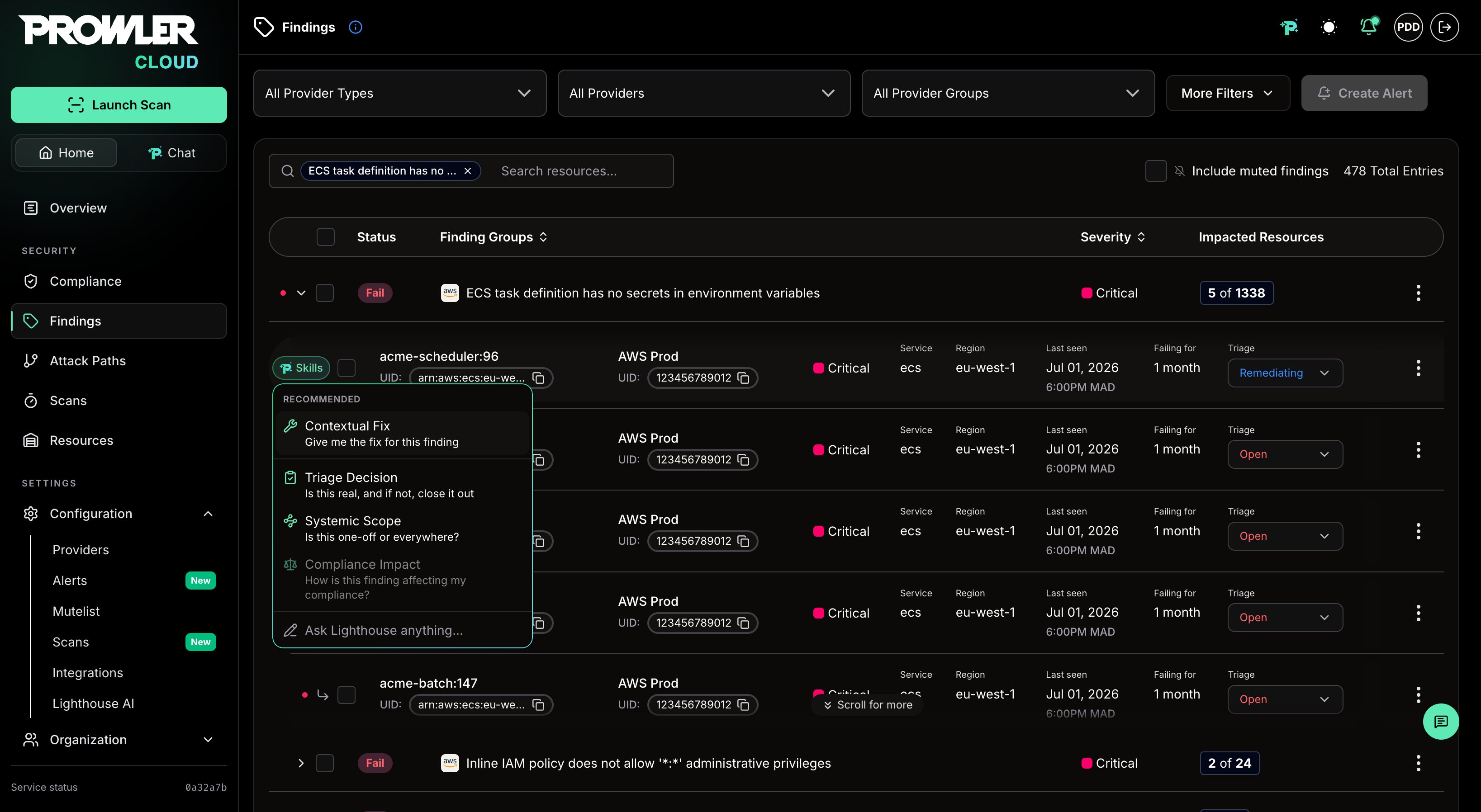
🤖 Lighthouse AI — Finding Skills
This feature is available exclusively in Prowler Cloud and Prowler Private Cloud with a subscription.
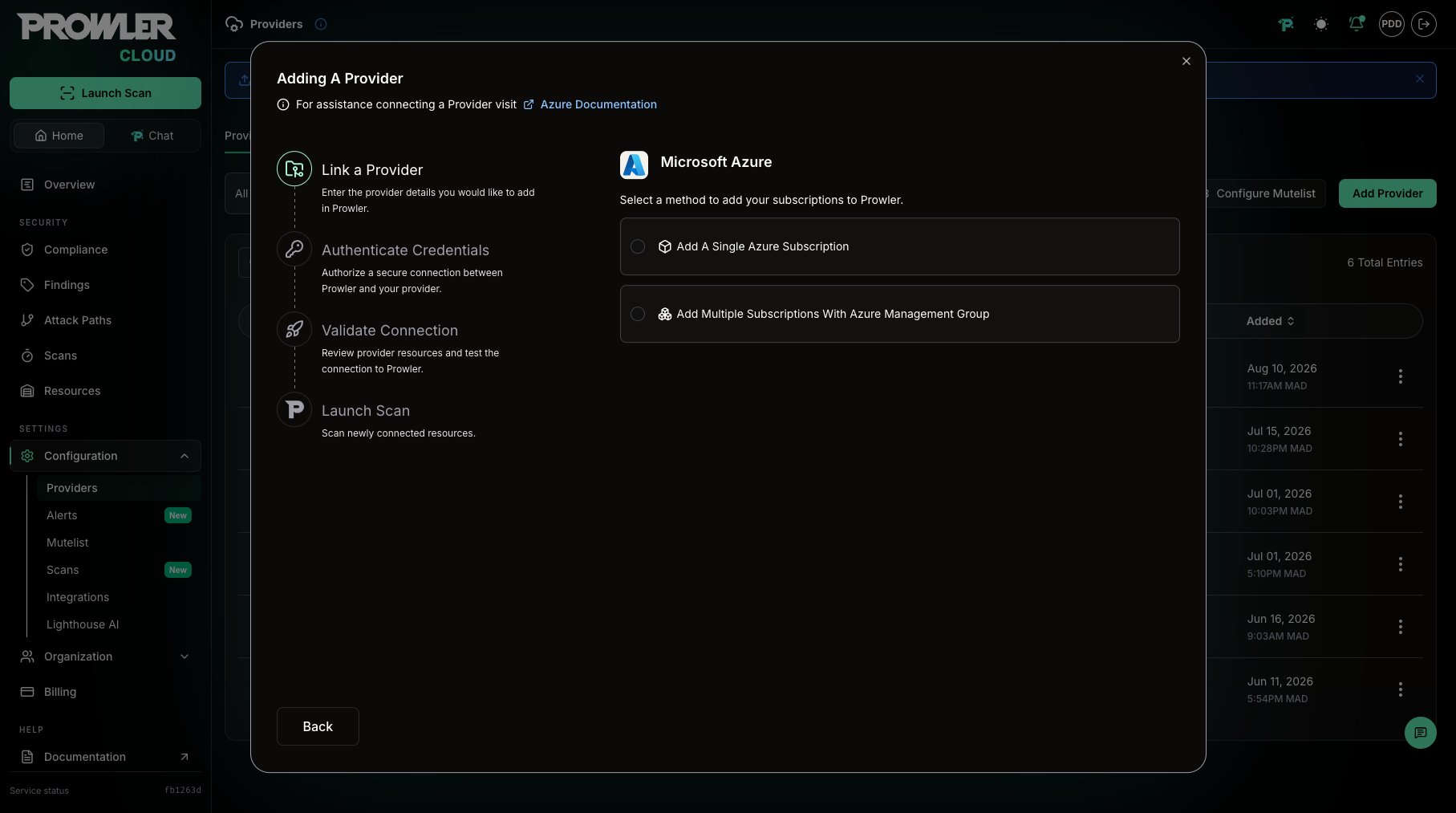
☁️ Azure Management Group Onboarding
This feature is available exclusively in Prowler Cloud and Prowler Private Cloud with a subscription.
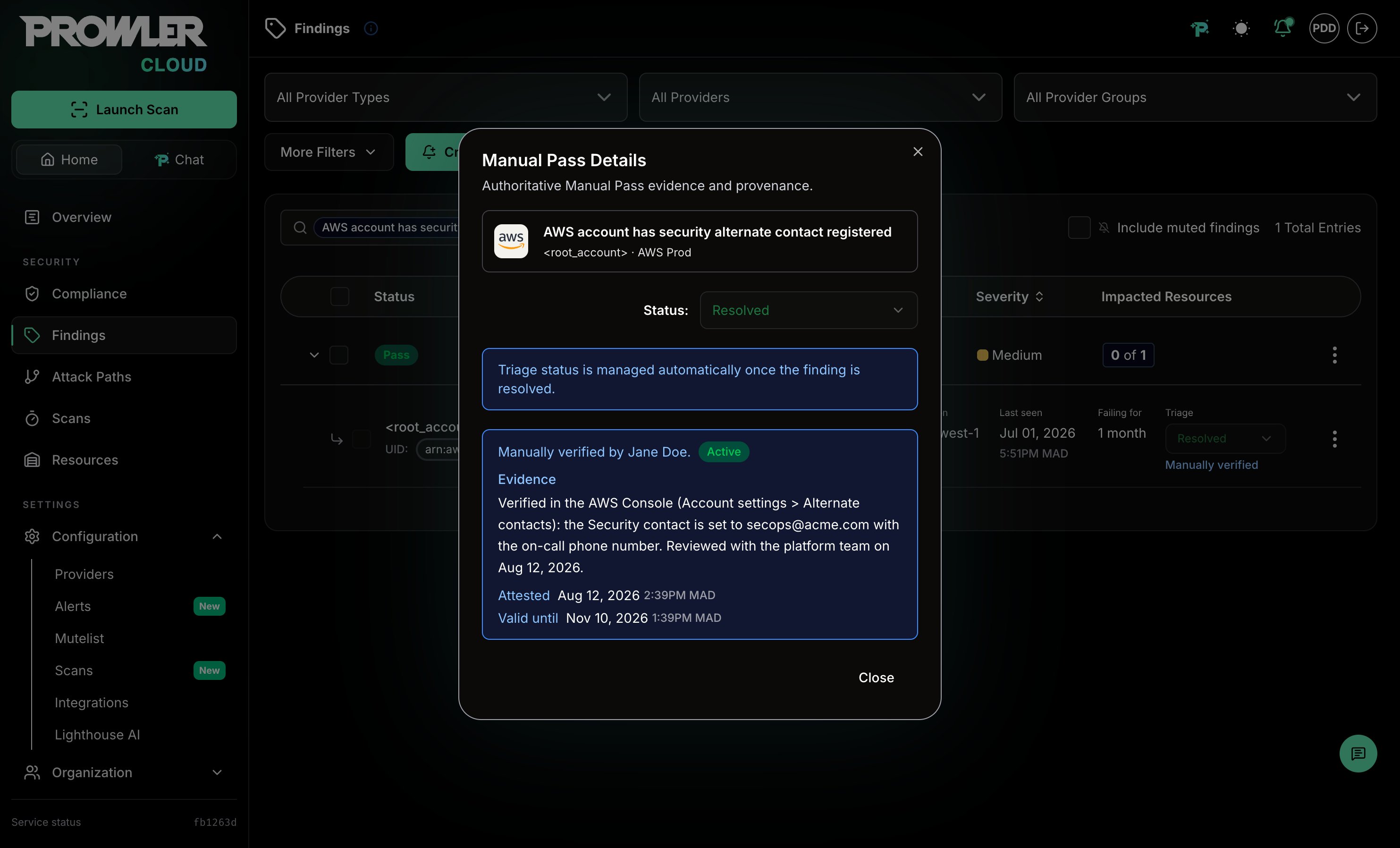
✅ Findings Triage — Verify MANUAL Findings as PASS
This feature is available exclusively in Prowler Cloud and Prowler Private Cloud with a subscription.
MANUAL findings. For these findings, and only for them, the triage status selector now offers Resolved: choosing it asks for the required written evidence and verifies the finding as passing. The finding then reports an effective PASS while preserving the raw MANUAL scan result, across findings, finding groups, compliance reports, and scans, with the attestation’s author, evidence, and validity always visible. Attestations expire automatically after 90 days, or as soon as a new scan reports a real failure, returning the finding to the review queue.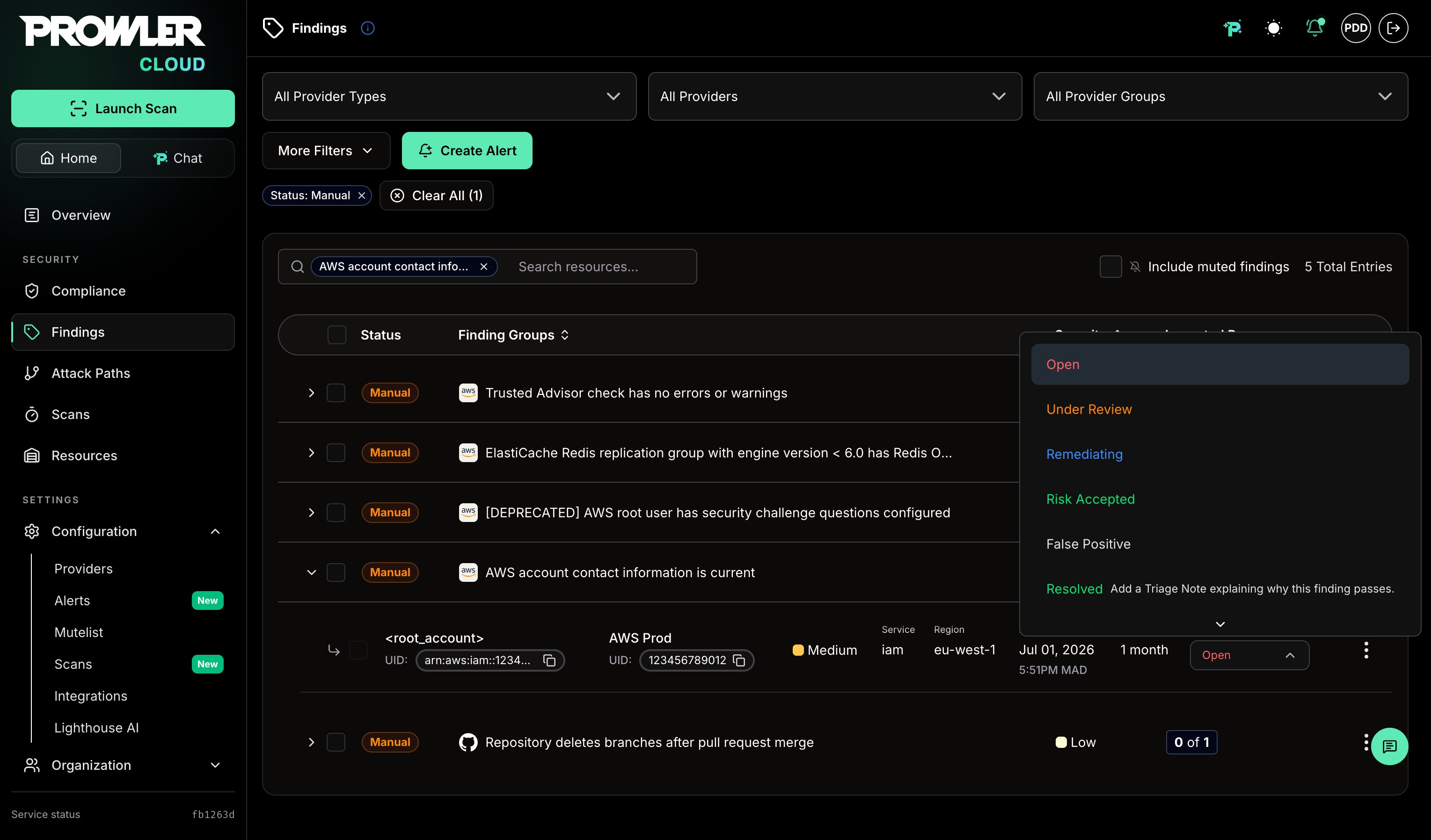
☁️ Prowler Cloud MCP — Organizations Management and Grouped Jira Dispatch
This feature is available exclusively in Prowler Cloud and Prowler Private Cloud with a subscription.
prowler_send_findings_to_jira also gains Cloud-only dispatch capabilities: select failed findings by check IDs against the latest completed scan, and send them in grouped mode, one Jira work item per check listing up to 50 affected resources, with per-group error reporting.Read more in the Prowler MCP tools documentation and its Jira operations reference.🕸️ Attack Paths — Grouped Graph with Outcome Destinations
This feature is available exclusively in Prowler Cloud and Prowler Private Cloud with a subscription.
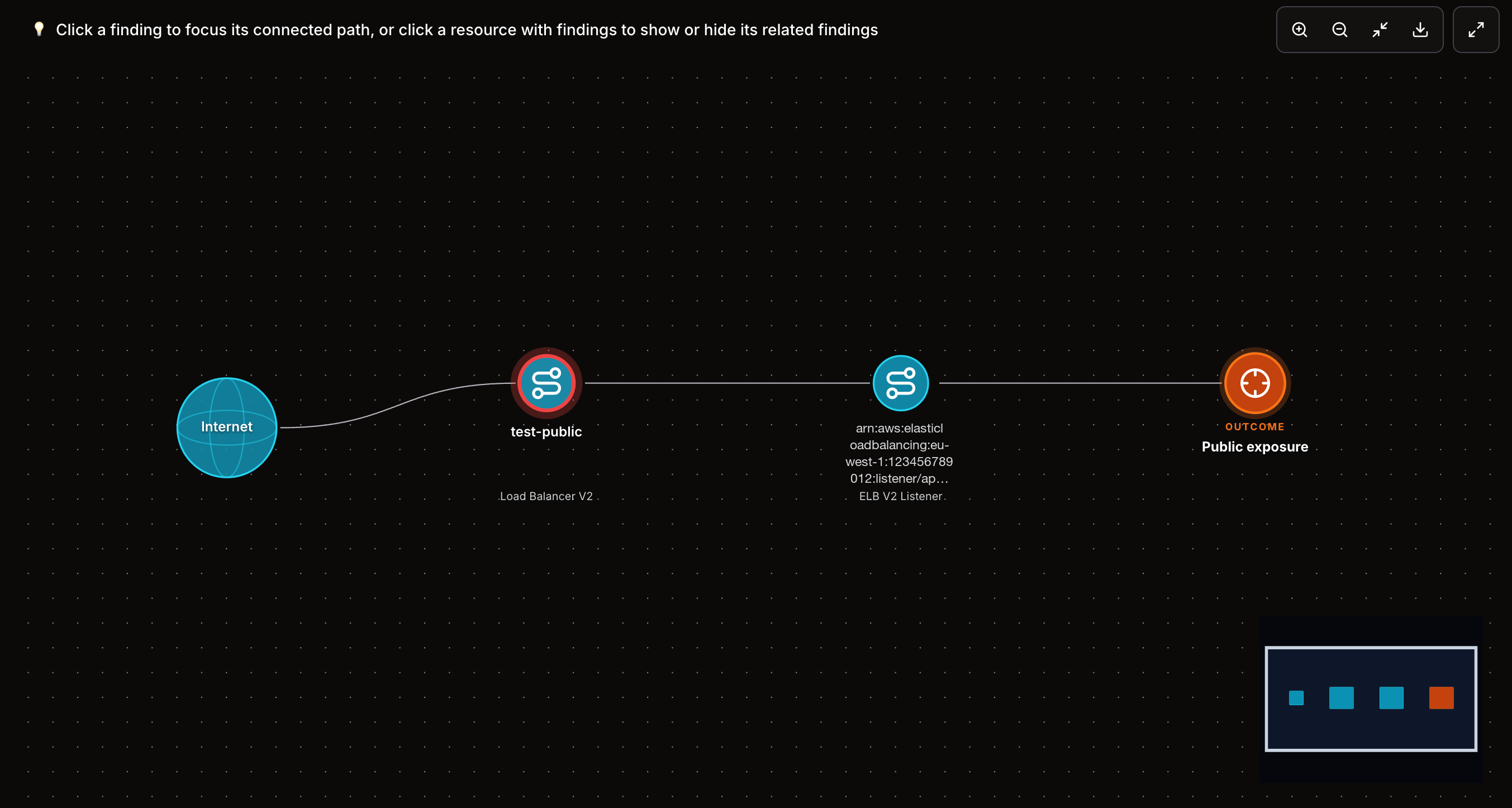
📚 New Compliance Framework — CMMC 2.0
The Cybersecurity Maturity Model Certification (CMMC) is the certification the US Department of Defense requires from contractors and suppliers that handle federal contract data. Prowler now includes CMMC 2.0 as a universal framework with all 149 requirements defined by the CMMC Program rule (32 CFR Part 170), organized in its three levels:- Level 1 (Foundational): 15 requirements for the basic safeguarding of Federal Contract Information, from FAR 52.204-21.
- Level 2 (Advanced): 110 requirements from NIST SP 800-171 Rev 2, protecting Controlled Unclassified Information.
- Level 3 (Expert): 24 enhanced requirements from NIST SP 800-172 for the most sensitive programs.
🔍 Checks
Microsoft 365
Twenty new Entra ID checks expand the coverage of CIS Microsoft 365 Foundations Benchmark v7.0.0:- Password protection: custom banned password list, on-premises enforcement, and lockout threshold and duration.
- Default user permissions: security group and Microsoft 365 group creation restricted, and guest invitations limited to allowed domains.
- Conditional Access: high and medium sign-in risk blocked, authentication transfer blocked, untrusted locations blocked, trusted named locations defined, sign-in frequency enforced, and token protection enforced.
- Sessions and authentication methods: idle session timeout configured, email one-time passcodes disabled, and Microsoft Authenticator context shown.
- PIM and access reviews: approval required to activate the Global Administrator and Privileged Role Administrator roles, and access reviews configured for guest users and privileged roles.
AWS
Two new checks detect hardcoded secrets:batch_job_definition_no_secretsscans Batch job definition environment variables and command parameters. Thanks to @praneetrajv!awslambda_layer_no_secrets_in_contentscans Lambda layer package content. Thanks to @ganiganesh25!
🙌 External Contributors
Thank you to our community contributors for this release!- @praneetrajv: AWS
batch_job_definition_no_secretscheck (#12117) - @ganiganesh25: AWS
awslambda_layer_no_secrets_in_contentcheck (#12233) - @andoniaf: GitHub
organization_repository_creation_limitednow reports low severity when repository creation is limited to private or internal visibility (#12164)
August 6, 2026
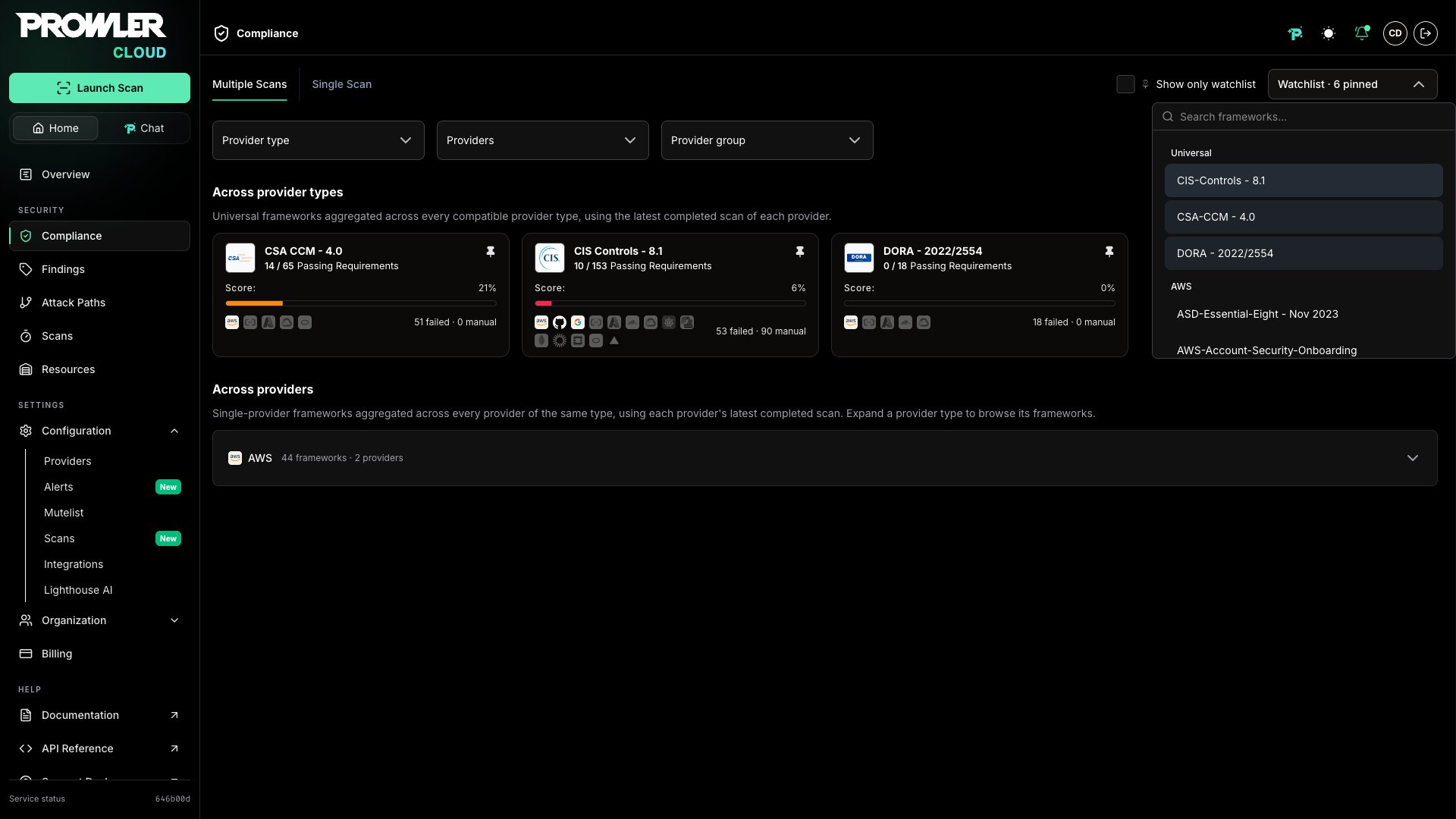
📌 Compliance Watchlist
This feature is available exclusively in Prowler Cloud and Prowler Private Cloud with a subscription.
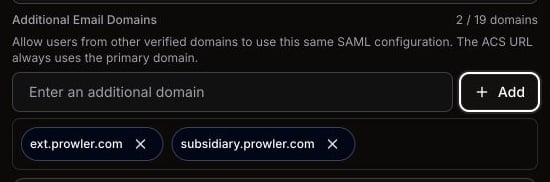
🔐 SAML SSO - Multiple Email Domains
This feature is available exclusively in Prowler Cloud and Prowler Private Cloud with a subscription.
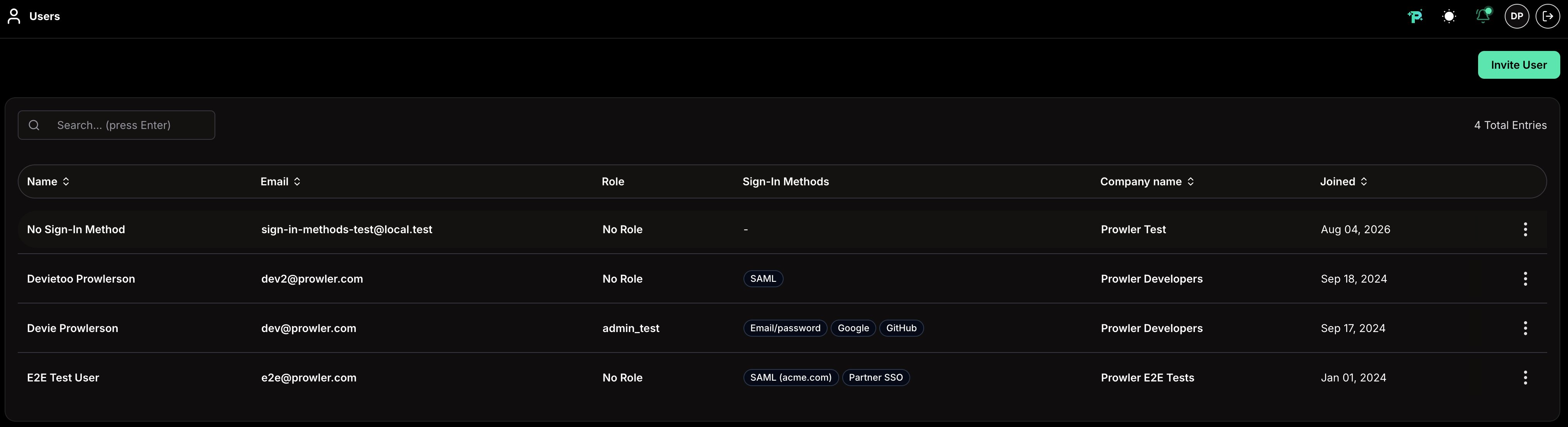
👥 User Sign-In Methods
This feature is available exclusively in Prowler Cloud and Prowler Private Cloud with a subscription.
🕸️ Attack Paths - Expanded AWS Privilege-Escalation Coverage
Attack Paths adds 20 AWS privilege-escalation queries from pathfinding.cloud, whileiam_policy_allows_privilege_escalation gains 22 additional escalation combinations.The new coverage includes service iam:PassRole paths across AWS Batch, Braket, Cognito Identity, ECS, EMR, EMR Serverless, GameLift, Glue, EC2 Image Builder, Kinesis Analytics, HealthOmics, EventBridge Scheduler, Systems Manager, and Step Functions. It also covers existing-resource abuse, permissions-boundary removal, role assumption, and IAM Identity Center permission-set policy injection.The query catalog now exposes each AWS query’s outcome category, distinguishing code execution, privilege escalation, public exposure, and resource inventory.Explore the full Attack Paths query catalog at Prowler Hub.Read more in the Attack Paths documentation.🔍 Checks
Microsoft 365
Twelve new checks expand the coverage of CIS Microsoft 365 Foundations Benchmark v7.0.0:- Admin Center: Shared Bookings is disabled.
- Defender: Priority account protection and strict preset security policies are enabled.
- Entra ID: Six checks cover device registration restrictions, local administrator behavior, device limits, LAPS, and BitLocker key visibility.
- Exchange Online: Personal accounts in Outlook on the web are disabled and Direct Send is rejected.
- Microsoft Teams: External access from trial-only tenants is blocked.
🔐 Security
- Prowler API, UI, SDK, and MCP container images now publish per-architecture Software Bills of Materials (SBOMs) and build-provenance attestations. Prowler Cloud production and Prowler Private Cloud images carry the same attestations.
- SDK and API container builds verify the checksums of downloaded PowerShell, Trivy, and zizmor binaries before installation.
- Grype now complements Trivy across the container-image security gates, detecting components and vulnerabilities that manifest-based scanners can miss and blocking fixable high and critical findings.
aiohttpwas upgraded to 3.14.3 to address CVE-2026-69244.cryptographywas upgraded to 50.0.0 to address CVE-2026-69247 and CVE-2026-69249.
August 3, 2026
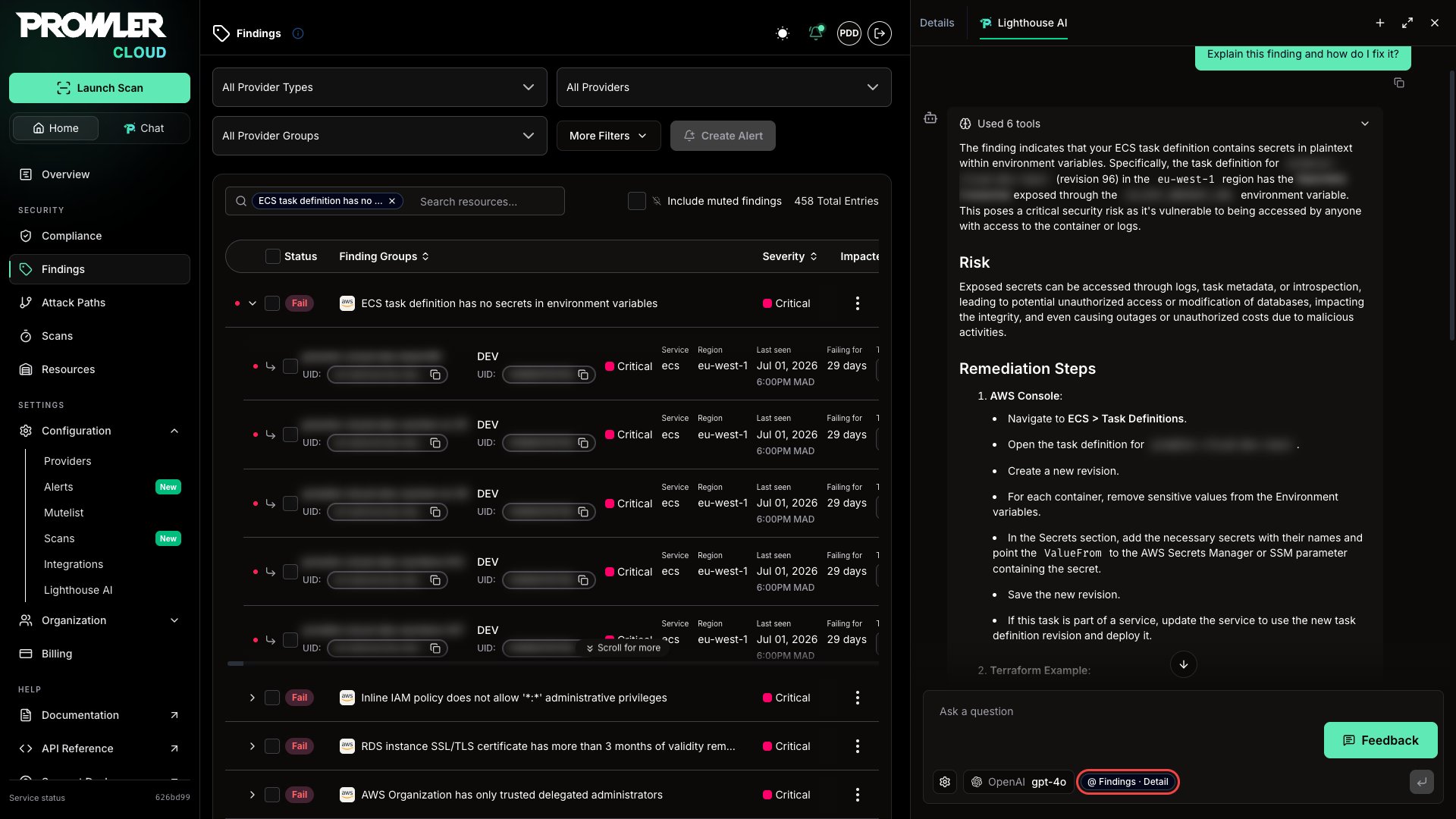
💬 Lighthouse AI — Context-Aware Chat and a Bigger Toolbox
This feature is available exclusively in Prowler Cloud and Prowler Private Cloud with a subscription.
🔌 Prowler MCP — Integrations, Users, and Roles
Prowler MCP gained three tool families, available on both the Cloud and the self-hosted Local MCP Server:- Integrations — manage where Prowler sends its results, with the full lifecycle for Amazon S3, AWS Security Hub, and Jira: create them, update credentials, configuration and attached providers, re-check connections, and delete them — plus turning findings into Jira work items directly from a conversation.
- Users — read-only tools to list the tenant users with their emails and identify the authenticated user.
- Roles — browse the RBAC roles defined in the tenant, inspect the capabilities each one grants, and set the role a user holds.
☁️ Prowler MCP — Cloud-Only Tools
This feature is available exclusively in Prowler Cloud and Prowler Private Cloud with a subscription. These tools are exposed only by the Cloud MCP Server at
https://mcp.prowler.com/mcp; the self-hosted Local MCP Server does not include them.prowler_cloud_* namespace adds 32 tools so your AI assistant can run Prowler Cloud workflows end to end instead of only reading from them:- Alerts — create and manage alert rules and email recipients, and browse the fired-alert history. Rule conditions can be dry-run before saving, so you can see what a rule would match without persisting anything.
- Findings Triage — set a finding’s triage status and attach notes documenting the decision. Unlike muting, the finding stays visible.
- Scan Scheduling — configure daily, interval, weekly, or monthly recurring scans, one provider at a time or applied across many at once.
- Scan Configurations — build reusable check and compliance selections and attach them to providers.
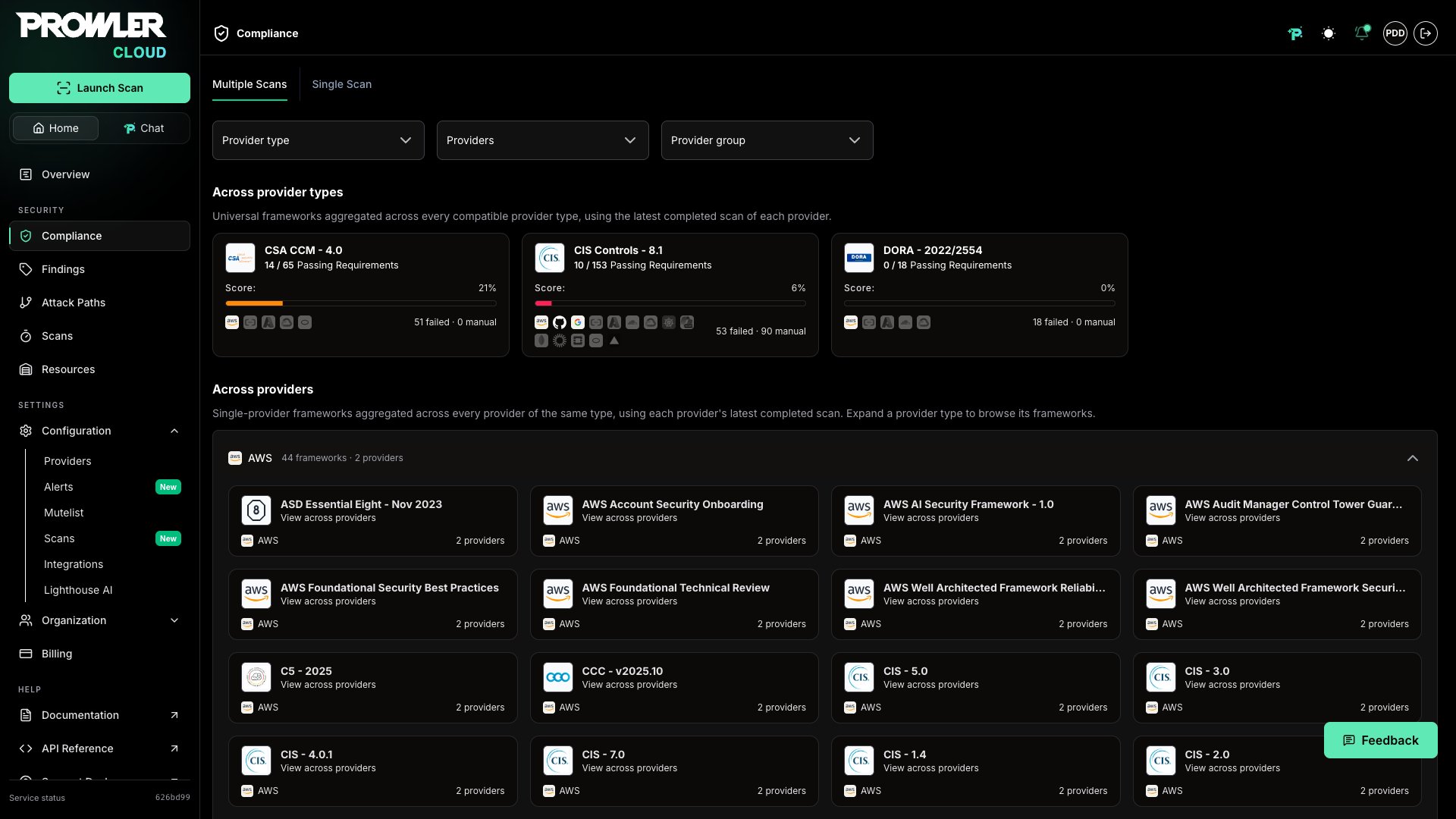
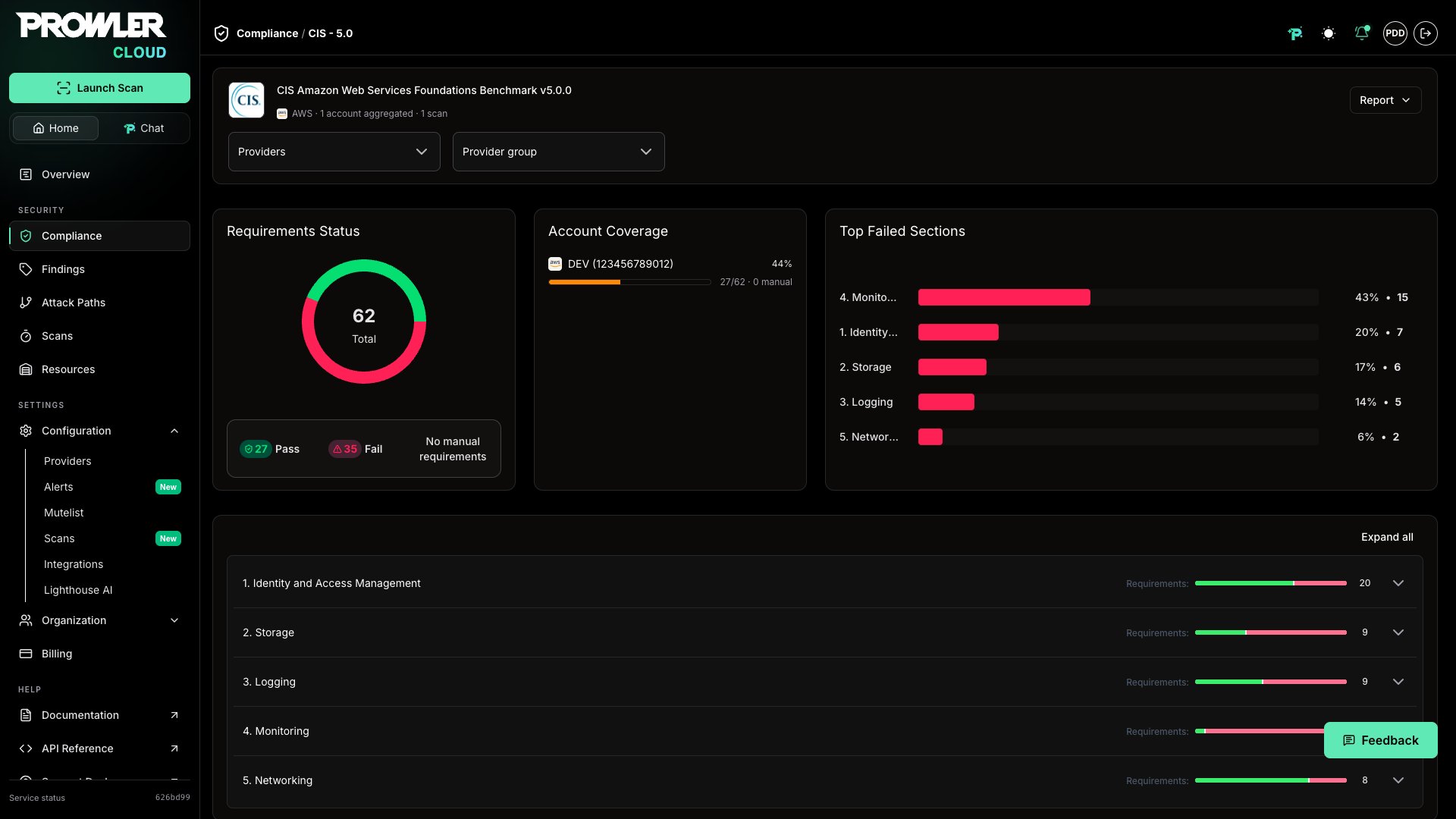
🧭 Compliance — Grouped by provider of the same type
This feature is available exclusively in Prowler Cloud and Prowler Private Cloud with a subscription.
☁️ GCP Organization Onboarding
This feature is available exclusively in Prowler Cloud and Prowler Private Cloud with a subscription.
🕸️ Attack Paths — More Privilege Escalation Queries
Attack Paths adds four AWS privilege-escalation detection queries from pathfinding.cloud. Thanks to @paramanandmallik!- STS-002 — cross-account role trust
- STS-003 — wildcard role trust
- IAM-022 — user permissions-boundary removal
- SSO-001 — IAM Identity Center permission-set escalation
🛡️ AWS Confidential Computing — Nitro Enclaves Checks
Prowler adds the first CSPM coverage for confidential computing workloads on AWS, with 11 new checks for Nitro Enclaves, developed together with Guillermo Ruiz from AWS.- Workload host environment (EC2) — five
ec2_confidential_workload_host_*checks for the parent instance: IMDSv2 not enforced, public IP exposure, unrestricted ingress, exposed vsock proxy ports, and hosts not running. - KMS attestation policy — six
kms_key_enclave_*checks for the key policies gating enclave secrets: attestation not enforced or bypassable, missing deployment binding, debug-mode attestations, PCR mismatches, and unknown enclave images.
🏢 New Provider — Huawei Cloud
Prowler now scans Huawei Cloud, with 25 checks across ten services: CTS, ECS, ELB, EVS, IAM, KMS, OBS, RDS, VPC, and WAF, plus the CIS Huawei Cloud Foundations Benchmark 1.0 compliance framework. Thanks to @tomitobio for their 1st provider in Prowler!To scan a Huawei Cloud account, export the IAM user’s access key credentials and run Prowler CLI:🔍 Checks
AWS
codecommit_repository_no_secrets, alongside the newcodecommitservice, scans files tracked at the tip of each repository’s default branch for hardcoded secrets. Thanks to @Sid-0602!glue_catalog_connection_no_secretsdetects secrets in Glue Data Catalog connection properties. Thanks to @l46983284-cpu, @Rishi943, and @UTKARSH698!ec2_instance_stopped_older_than_specific_daysdetects EC2 instances stopped longer than a configurable number of days (default 30). Thanks to @Nithin078!sagemaker_endpoint_config_kms_encryption_enabledverifies SageMaker endpoint configurations use a KMS key for storage volume encryption. Thanks to @Nithin078 and @l46983284-cpu!
📤 OCSF Output — MITRE ATT&CK Enrichment
OCSF detection finding output now populatesfinding_info.analytic with the Prowler check rule and finding_info.attacks with MITRE ATT&CK technique and tactic objects for findings with MITRE ATT&CK compliance metadata. Thanks to @AlexanderSanin!🐞 Fixed
- AWS Security Hub integrations now persist successful recovery checks during finding delivery, keeping connection status and the last-checked time accurate.
- Social sign-up now creates authentication, tenant, and membership records in a single transaction, fully rolling back failed provisioning to prevent incomplete accounts.
- The SAML configuration form keeps the ACS URL field stable while generating the callback URL and exposes the copy action only after a valid URL is available.
- SAML users without a
userTypeattribute and without an existing role now receive a least-privilegeread_onlyfallback role, so role-dependent operations continue to work without granting management permissions.
🔐 Security
- Provider deletion, connection checks, scan creation, provider secrets, provider groups, and daily schedules now respect role provider-group visibility.
- HTML reports escape provider-originated finding fields, preventing stored cross-site scripting through malicious cloud resource tags. https://github.com/prowler-cloud/prowler/security/advisories/GHSA-c2jg-2778-ggm4
- Authentication with an API key whose owning user was deleted now returns
401, and user deletion revokes the user’s API keys across all their tenants.
🙌 External Contributors
Thank you to our community contributors for this release!- @tomitobio: Huawei Cloud provider with CIS 1.0 benchmark (#11950)
- @paramanandmallik: four AWS privilege-escalation Attack Paths queries (#11460)
- @Sid-0602: AWS
codecommitservice andcodecommit_repository_no_secretscheck (#11846) - @l46983284-cpu, @Rishi943, and @UTKARSH698: AWS
glue_catalog_connection_no_secretscheck (#11963) - @Nithin078: AWS
ec2_instance_stopped_older_than_specific_days(#12076) andsagemaker_endpoint_config_kms_encryption_enabled(#12118, co-authored with @l46983284-cpu) checks - @AlexanderSanin: MITRE ATT&CK enrichment in OCSF detection finding output (#11492)
- @stefanobaldo: GCP gen2 Cloud Functions IAM policy retrieval is now thread-safe (#12107)
- @rayair250-droid: GCP SSH and RDP firewall checks now detect exposed ports in any position within multi-port rules (#12115)
- @jbchief-dev: secret ignore patterns now use Kingfisher-compatible LF line indexing (#12141)
- @bmbferreira: Helm chart improvements — immutable chart versions on release (#12056) and capped Celery worker concurrency (#12054)
July 24, 2026
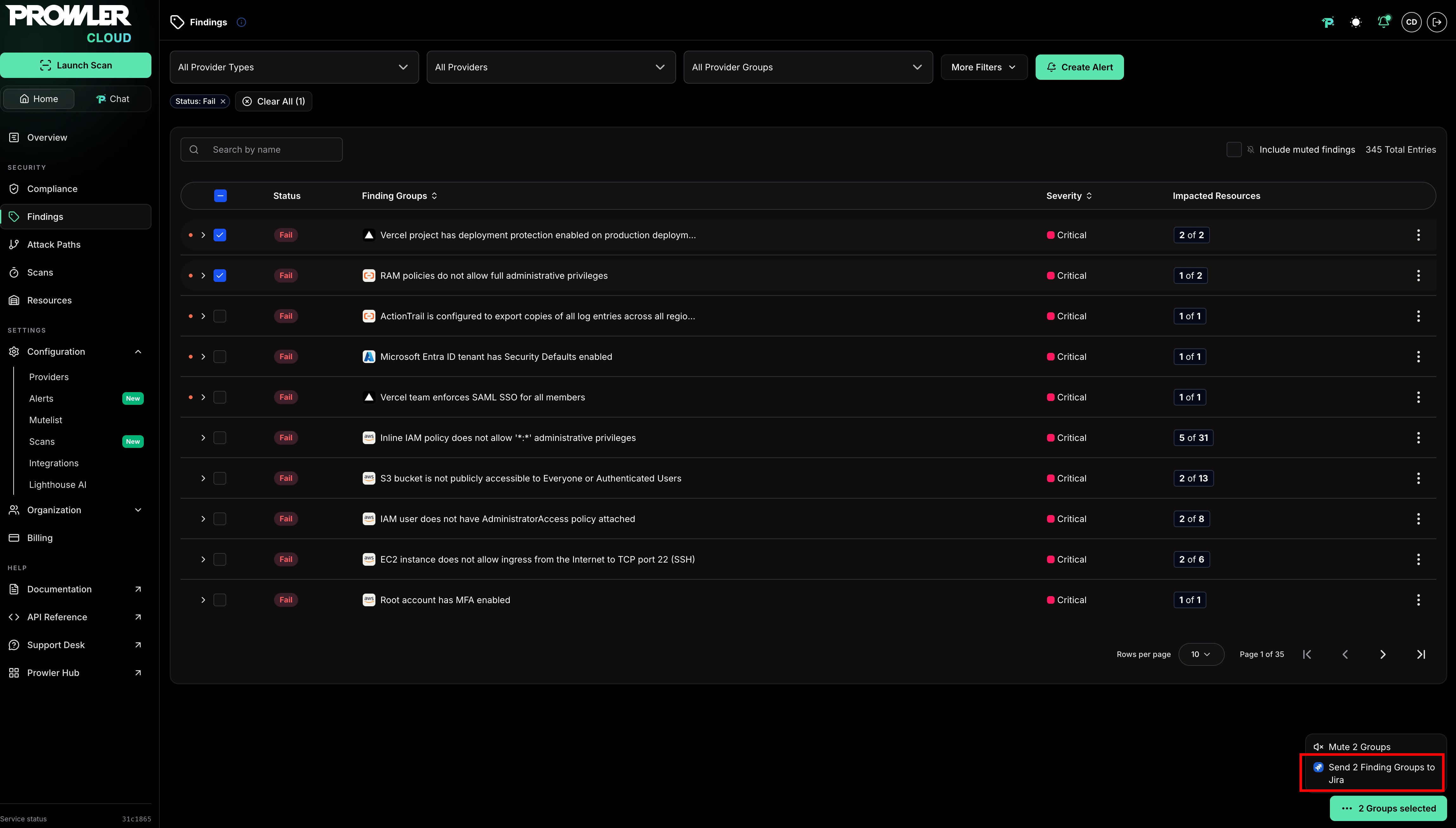
🎫 Finding Groups - Jira
This feature is available exclusively in Prowler Cloud and Prowler Private Cloud with a subscription.
🕸️ Attack Paths - Queries
This feature is available exclusively in Prowler Cloud and Prowler Private Cloud with a subscription.
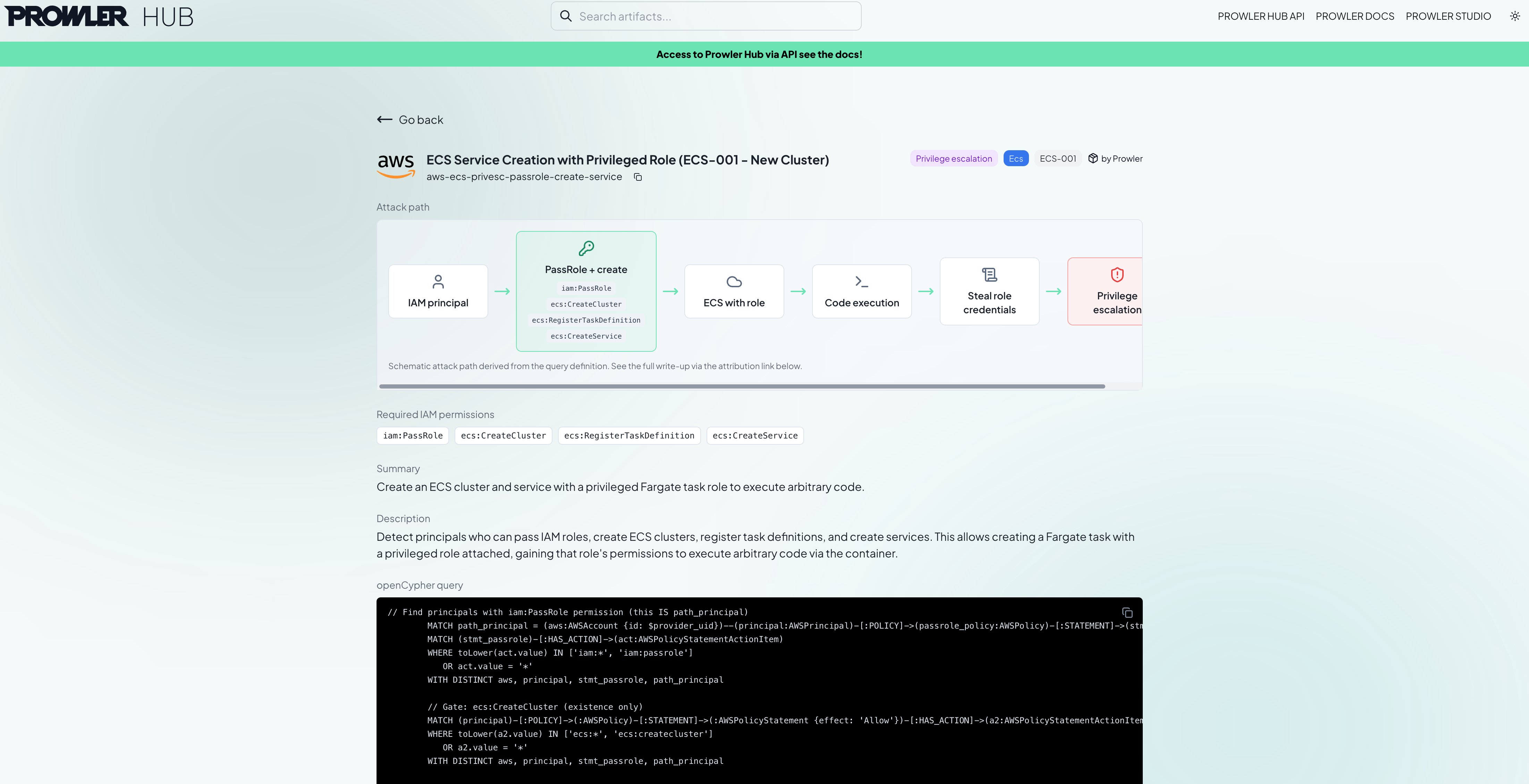
🧑🏫 New Tutorials: Connect Your AI Agents to Prowler Cloud
This feature needs a Prowler Cloud API key, so it is available exclusively in Prowler Cloud and Prowler Private Cloud with a subscription.
☁️ Region-less Oracle Cloud Infrastructure Setup
Oracle Cloud Infrastructure (OCI) provider credentials no longer require a region. Existing clients can still send the legacyregion field for compatibility, but the API ignores it before storing credentials or starting a scan. This removes an unnecessary step from OCI onboarding.Read more in the OCI documentation.🔍 Checks
AWS
sagemaker_notebook_instance_no_secretsscans theOnCreateandOnStartlifecycle scripts of SageMaker notebook instances for hardcoded API keys, passwords, tokens, connection strings, and other secrets. Thanks to @kiranrajsg!
🔐 Security
- Integration responses and operations now respect provider visibility, preventing hidden-provider disclosure and blocking unauthorized attachment, connection checks, Jira dispatches, edits, and deletion.
- Next.js was updated from 16.2.9 to 16.2.11, patching four high-severity and five medium-severity vulnerabilities.
- The unused
npmCLI was removed from the UI container image, eliminating the bundlednode-tarCVE-2026-59873 and reducing exposure to future bundled npm vulnerabilities. - Vitest and its browser packages were updated from 4.1.8 to 4.1.10, resolving the critical
@vitest/browserfile-access permission bypass. These are development dependencies and have no runtime impact. - Kubernetes kubeconfig validation now blocks legacy
auth-provider.config.cmd-pathcommand authentication, closing a command-execution bypass. next-authwas updated from 5.0.0-beta.30 to 5.0.0-beta.32, patching two critical Auth.js advisories: existence-based authorization checks that could fail open when a provider is misconfigured, and a homoglyph@bypass in email address normalization. The bump also pulls in the patched@auth/core0.41.3 transitively.
🙌 External Contributors
Thank you to our community contributors for this release!- @kiranrajsg: AWS
sagemaker_notebook_instance_no_secretscheck (#11843) - @owenchenxy: Alibaba Cloud SSH and RDP security group checks now handle capitalized
Policy="Accept"values correctly (#12049) - @rsaladra: S3 bucket name validation no longer raises an invalid escape sequence
SyntaxWarningat startup (#12041) - @SujayKulkarni-2211: Updated the AWS check count in the README (#12011)
July 17, 2026
💬 Lighthouse AI - Side Chat
This feature is available exclusively in Prowler Cloud and Prowler Private Cloud with a subscription.
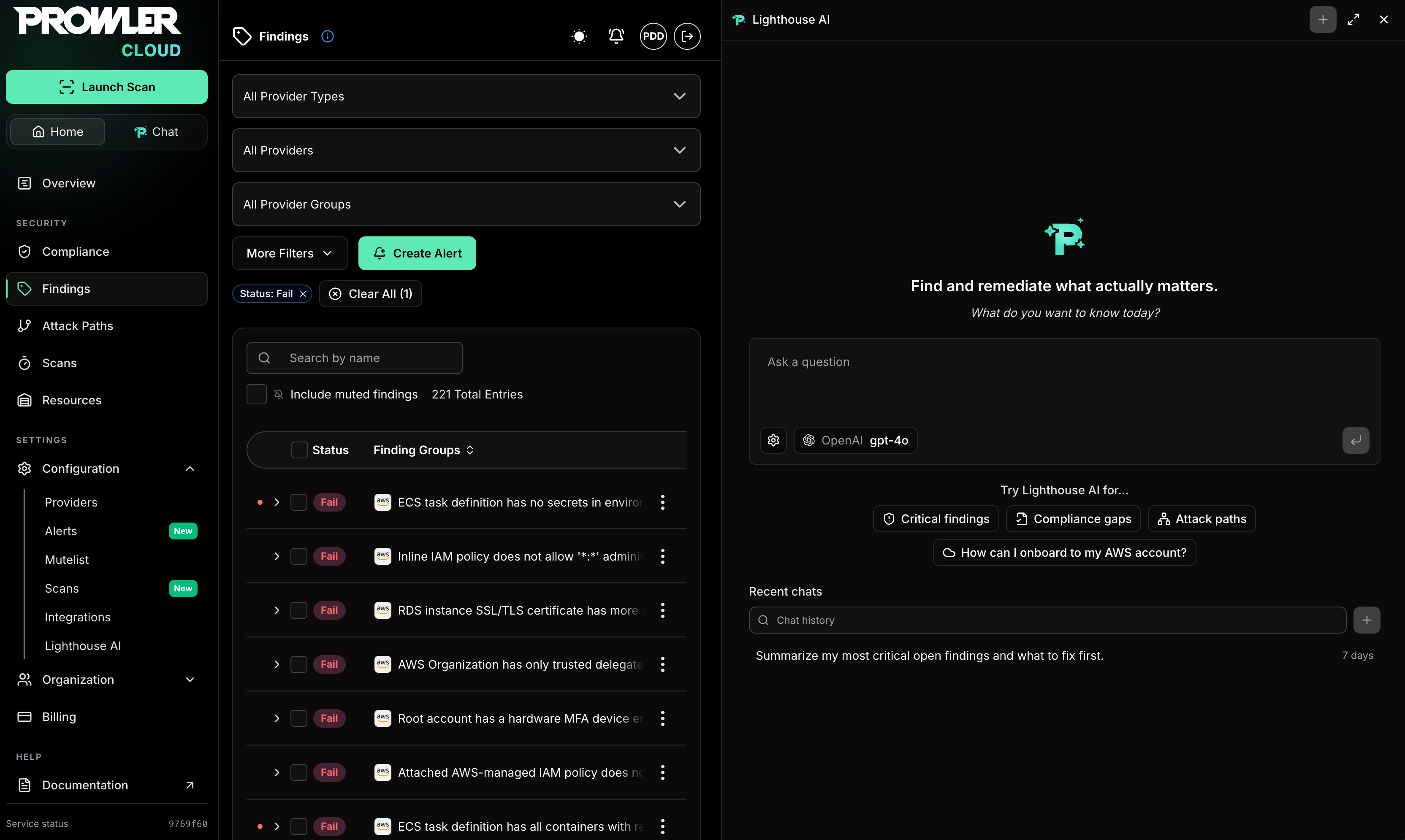
🤖 Lighthouse AI - Take Action
This feature is available exclusively in Prowler Cloud and Prowler Private Cloud with a subscription.
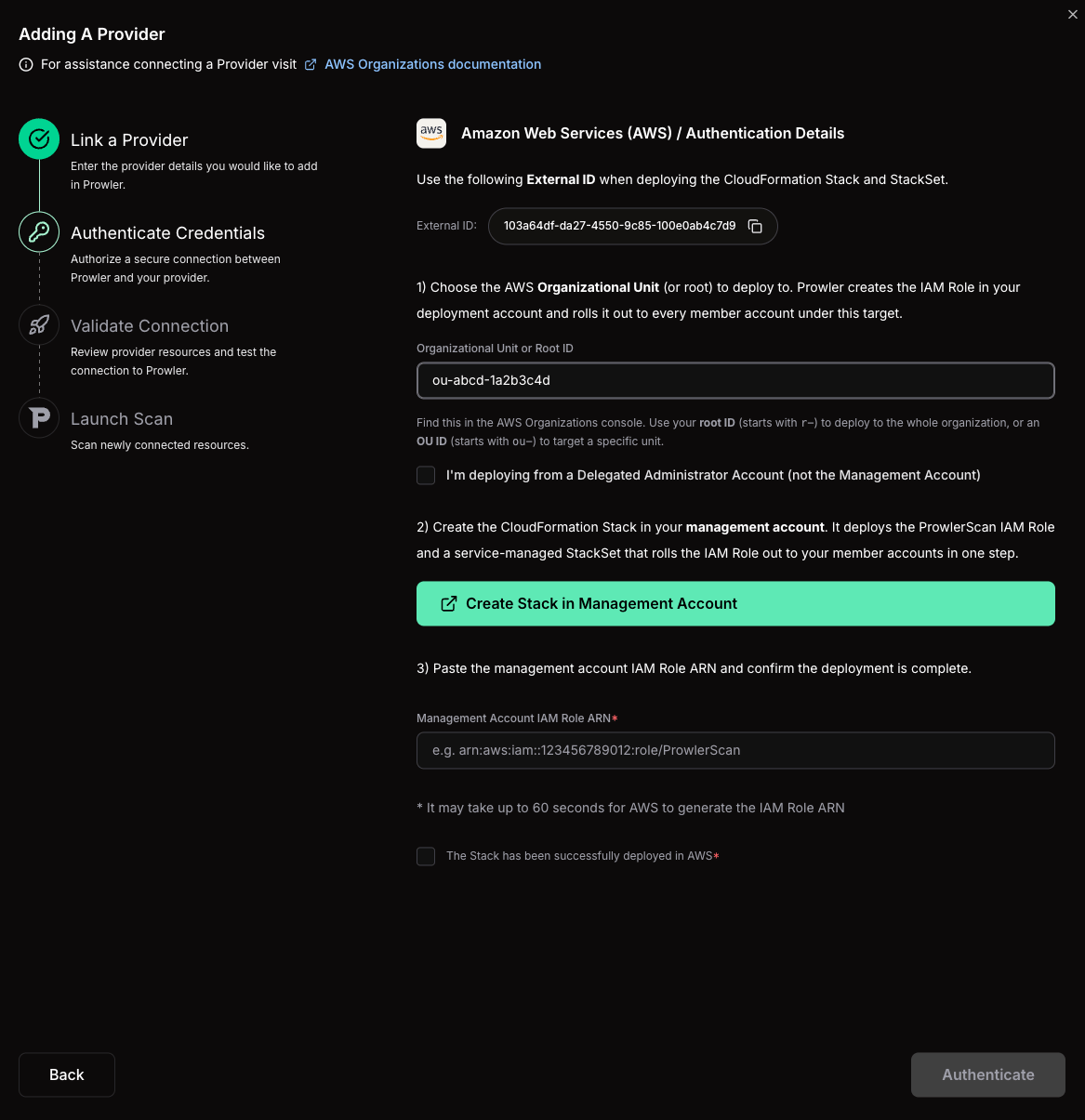
☁️ One-step AWS Organizations onboarding
This feature is available exclusively in Prowler Cloud and Prowler Private Cloud with a subscription.
🎯 Scan configurations: exclude checks and services
This feature is available exclusively in Prowler Cloud and Prowler Private Cloud with a subscription.
excluded_checks and excluded_services to narrow the execution scope. Skip individual checks or entire services per provider, and the scan does not run them at all: less noise, faster scans, and no findings you would mute anyway.Read more in the Scan Configuration documentation.🧭 Redesigned sidebar navigation
The sidebar was redesigned around how you actually work: grouped sections for security, settings, and help, a Home/Chat switch at the top, collapsible configuration entries, clearer active states, and a responsive mobile overlay.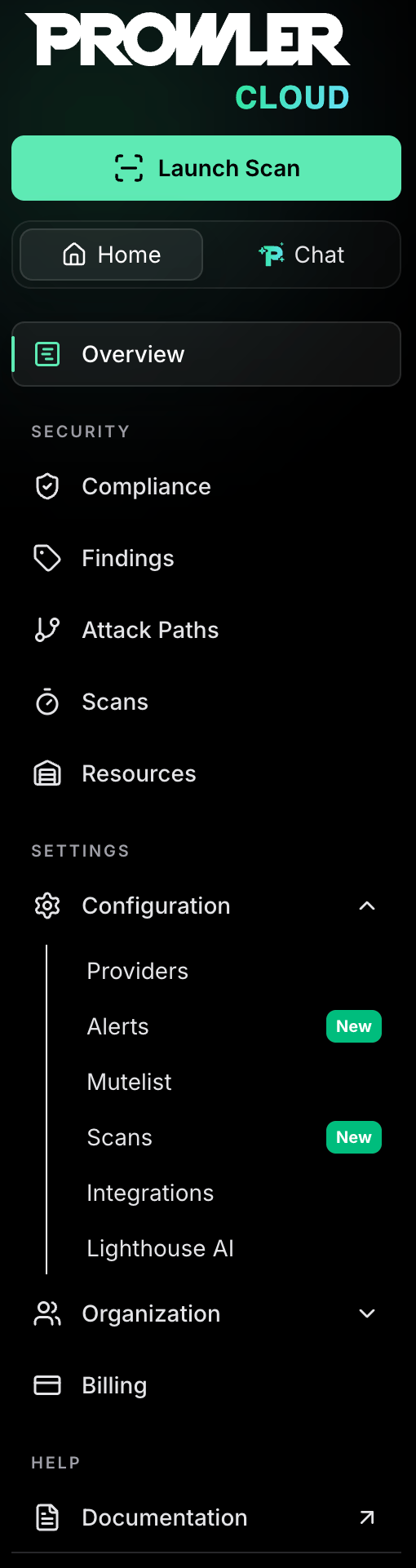
🔌 Prowler MCP tools renamed to prowler_*
Core Prowler tools in Prowler MCP moved from the prowler_app_* prefix to the shorter prowler_* namespace, and the MCP documentation was restructured around it. Legacy prowler_app_* names keep working in Lighthouse AI, so existing setups are not broken.Read more in the Prowler MCP tools reference.🔐 Security
- Jira integration credentials now only accept bare Atlassian site names (letters, numbers, and hyphens), and Jira tenant information requests validate site names and no longer follow redirects.
- Social account linking now requires a verified matching email from both the identity provider and the existing user account, and account connection notification emails are disabled.
- 13 advisories reported by
pnpm auditon the UI (3 high, 9 moderate, 1 low) are resolved with patched versions ofhono,ws,vite,dompurify,js-yaml,@opentelemetry/core, and@babel/core, includinghonoCVE-2026-59896.
🙌 External Contributors
No external contributors in this release.Special mention to @jchrisfarris, whose full-organization CloudFormation template from v5.34.0 powers the new one-step AWS Organizations onboarding (#10403).See the full release notes on GitHub for the complete list of changes.July 15, 2026
🏷️ New product names
The Prowler family has grown, and the names now say what each product is. Same products, clearer names:Prowler products:- Prowler Cloud — the managed cloud security platform operated by the Prowler team.
- Prowler Private Cloud (formerly Prowler Enterprise) — the self-hosted deployment of Prowler Cloud in your own environment.
- Prowler Hub — the free public library of versioned checks, cloud service artifacts, and compliance frameworks.
- Prowler Lighthouse AI — The Agentic Cloud Defender in Prowler Cloud and Prowler Private Cloud.
- Prowler MCP — the MCP server that connects AI assistants and agents to Prowler, including the IDE plugins.
- Prowler CLI — the command-line scanner for all supported providers.
- Prowler Local Server (formerly Prowler App) — the self-hosted web application and API to run scans, visualize findings, and manage providers.
- Prowler Local Dashboard — the web dashboard for visualizing Prowler CLI scan results, distributed with the CLI.
- Prowler SDK — the Python library behind Prowler CLI and Prowler Local Server.
🧭 Cross-Provider Compliance
This feature is available exclusively in Prowler Cloud and Prowler Private Cloud with a subscription.
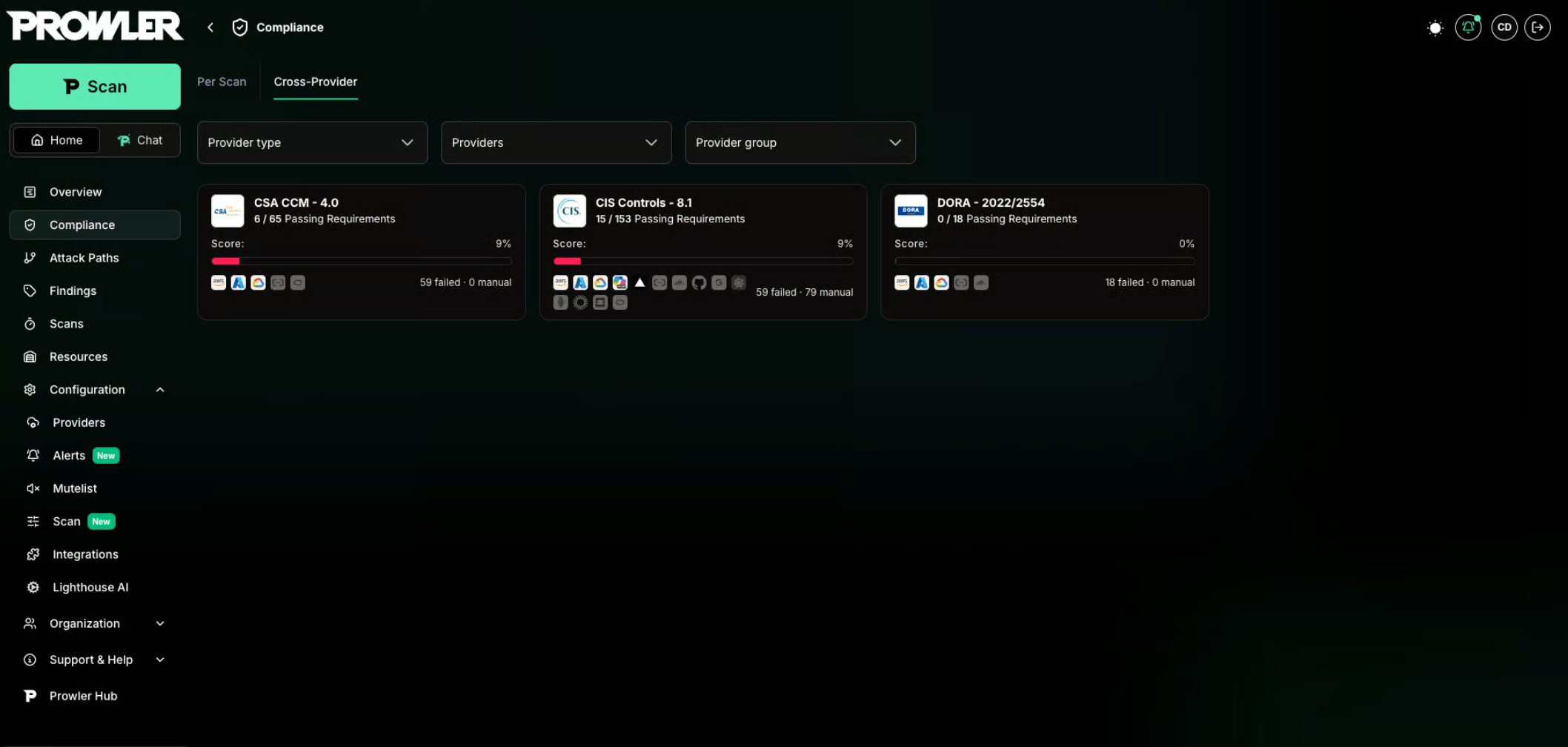
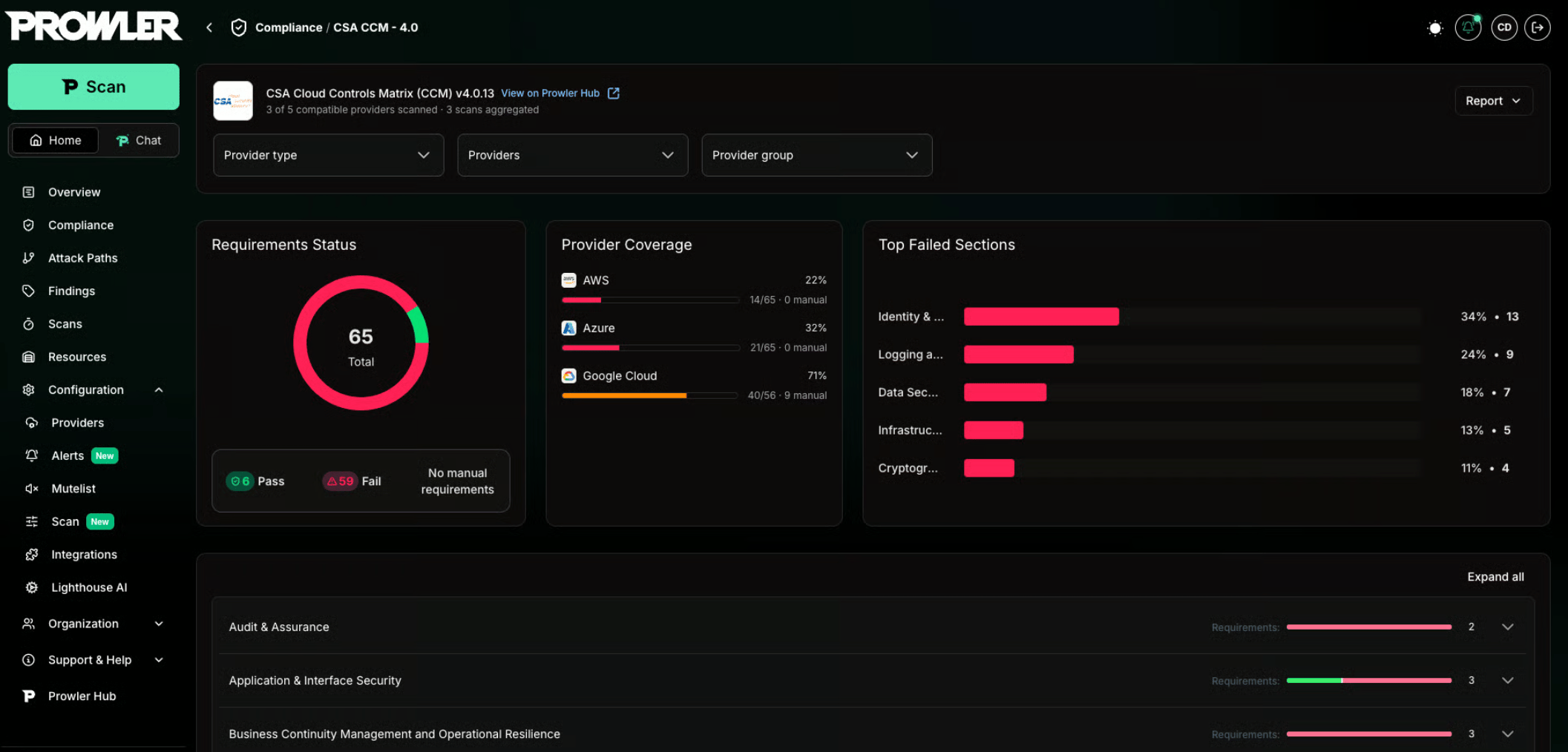
- CIS Controls 8.1 — AWS, Azure, Google Cloud, Microsoft 365, Kubernetes, GitHub, Google Workspace, Okta, Oracle Cloud, Alibaba Cloud, Cloudflare, MongoDB Atlas, OpenStack, and Vercel.
- CSA CCM 4.0 — AWS, Azure, Google Cloud, Alibaba Cloud, and Oracle Cloud.
- DORA 2022/2554 — AWS, Azure, Google Cloud, Alibaba Cloud, and Cloudflare.
🏢 New Provider — E2E Networks
Prowler now scans E2E Networks, with 27 checks spanning compute nodes, networking, security groups, load balancers, block and file storage, and managed databases. Thanks to @deepak7093 for their 1st provider in Prowler!Available in the Prowler CLI:🔐 Security
User role relationship updates in the API are now limited to the active tenant, preserving the role assignments the same user holds in other tenants.🔍 Checks
AWS
ec2_ami_account_block_public_access— verifies AMI block public access is enabled at the account level in each Region, so AMIs cannot be shared publicly. Thanks to @goutham-hari!datapipeline_pipeline_no_secrets_in_definition— scans Data Pipeline object fields, parameter objects, and parameter values for hardcoded secrets with Kingfisher. Thanks to @YinkaMetrics!elbv2_listener_pqc_tls_enabled— verifies ELBv2 HTTPS/TLS listeners use post-quantum TLS security policies with TLS 1.2 or higher, helping reduce harvest-now-decrypt-later exposure.amplify_app_no_secrets_in_environment— scans Amplify app and branch environment variables and build settings (buildSpec) for hardcoded secrets with Kingfisher. Thanks to @Deep070203!
Azure
app_function_ensure_http_is_redirected_to_https— verifies that Function Apps enforce HTTPS-only traffic. Thanks to @amandalal007!
Kubernetes
core_minimize_hostpath_volume_mounts— detects Pods that usehostPathvolumes. Thanks to @0xTaoZ!core_readonly_root_filesystem_enabled— verifies that every container in each Pod explicitly setsreadOnlyRootFilesystem: truein its security context. Thanks to @Weedle02!
STACKIT
iaas_server_public_ip_attached— flags IaaS servers that have a public IP address directly attached to a network interface. Thanks to @johannes-engler-mw!
🙌 External Contributors
Thank you to our community contributors for this release!- @jchrisfarris — Deploy AWS Organizations with the CloudFormation template in one step (#10403)
- @deepak7093 — New E2E Networks provider: 27 checks across compute nodes, networking, security groups, load balancers, block/file storage, and managed databases (#11654)
- @goutham-hari — AWS
ec2_ami_account_block_public_accesscheck (#11828) - @YinkaMetrics — AWS
datapipeline_pipeline_no_secrets_in_definitioncheck (#11821) - @amandalal007 — Azure
app_function_ensure_http_is_redirected_to_httpscheck (#11929) - @0xTaoZ — Kubernetes
core_minimize_hostpath_volume_mountscheck (#11837) - @Weedle02 — Kubernetes
core_readonly_root_filesystem_enabledcheck (#11835) - @johannes-engler-mw — STACKIT
iaas_server_public_ip_attachedcheck (#11549) - @janderik — Trailing newlines added to compliance, region, and fixture data files for POSIX compliance (#11765)
- @Deep070203 — AWS
amplify_app_no_secrets_in_environmentcheck (#11825)
July 7, 2026
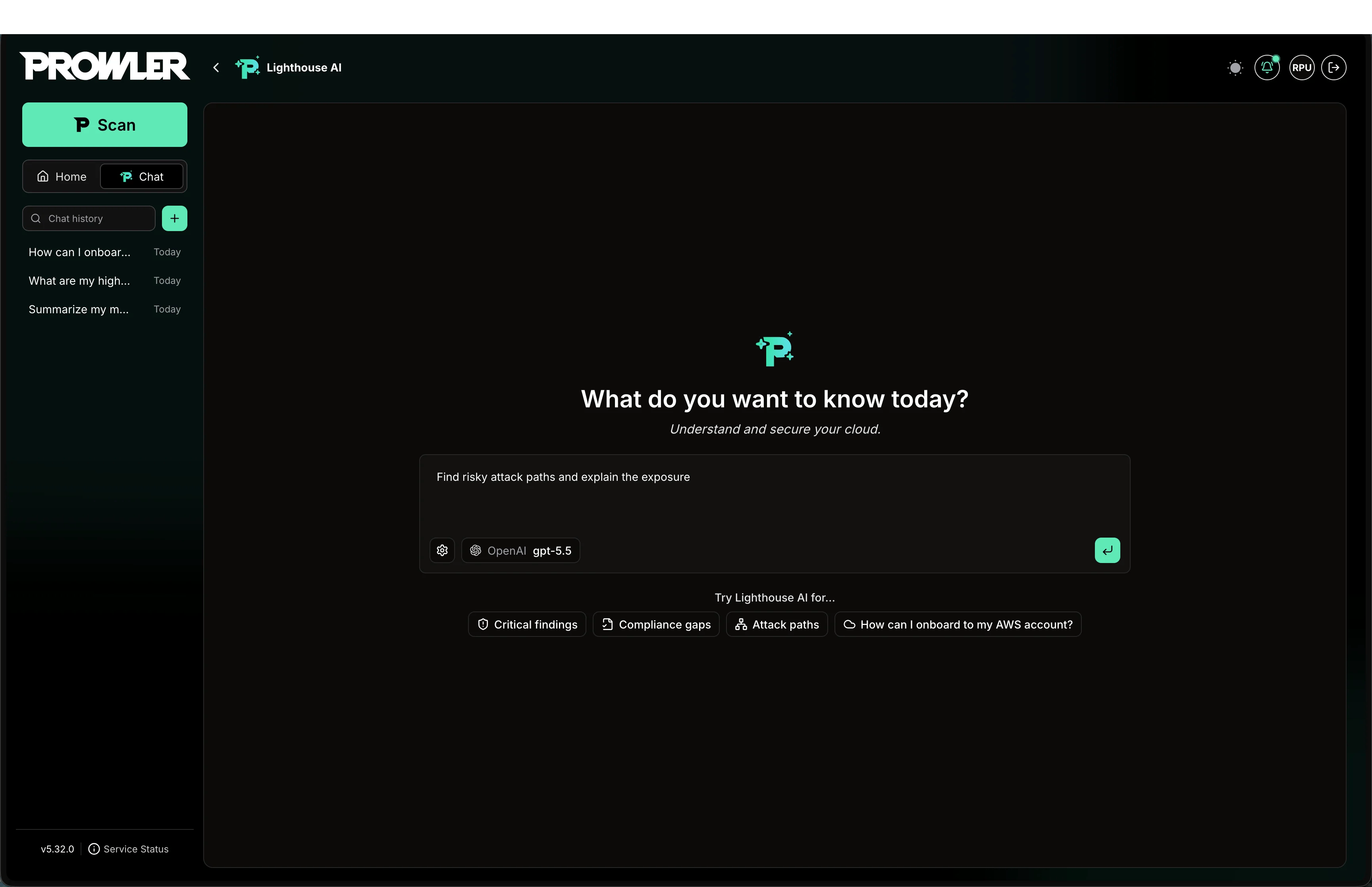
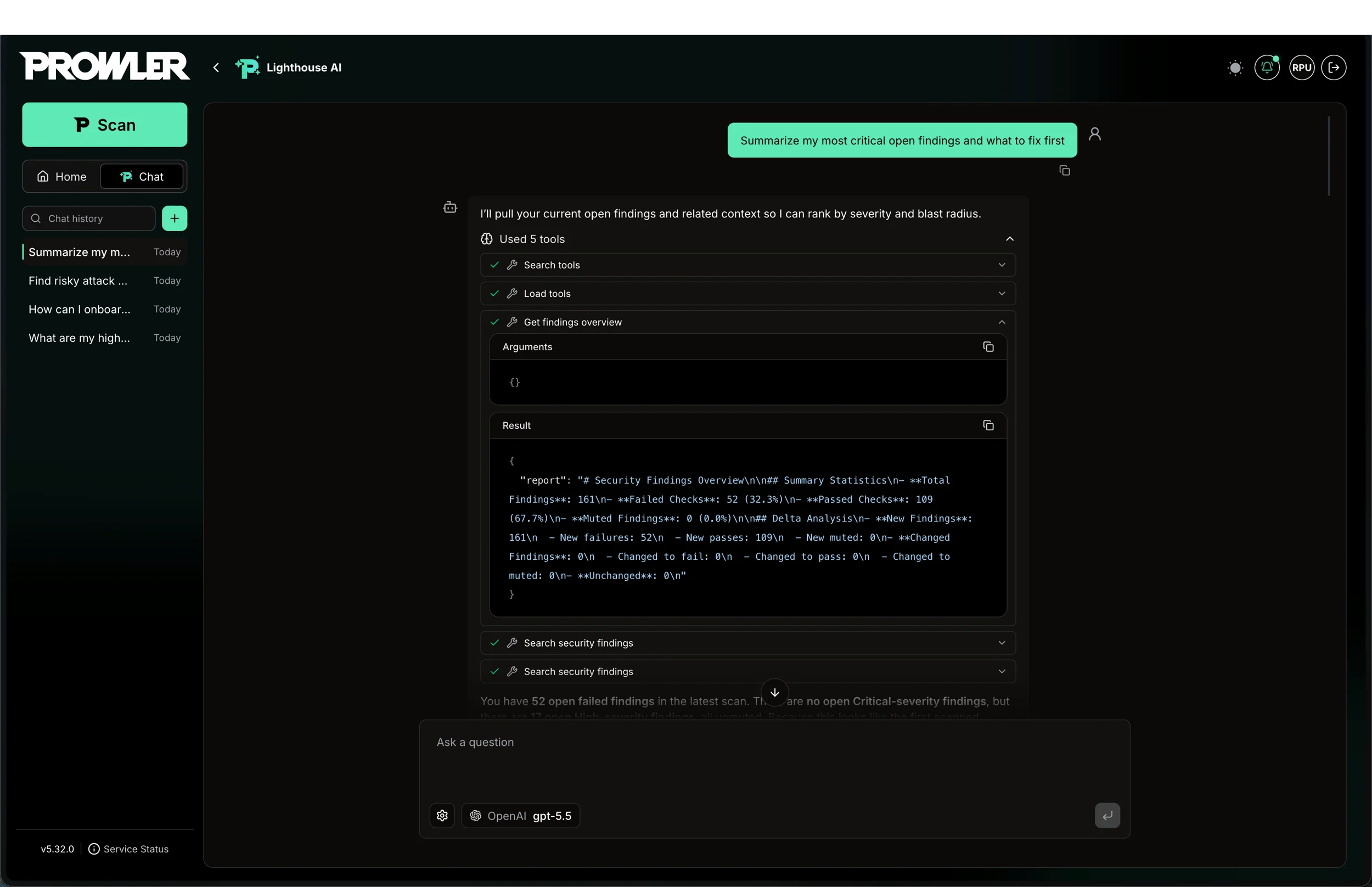
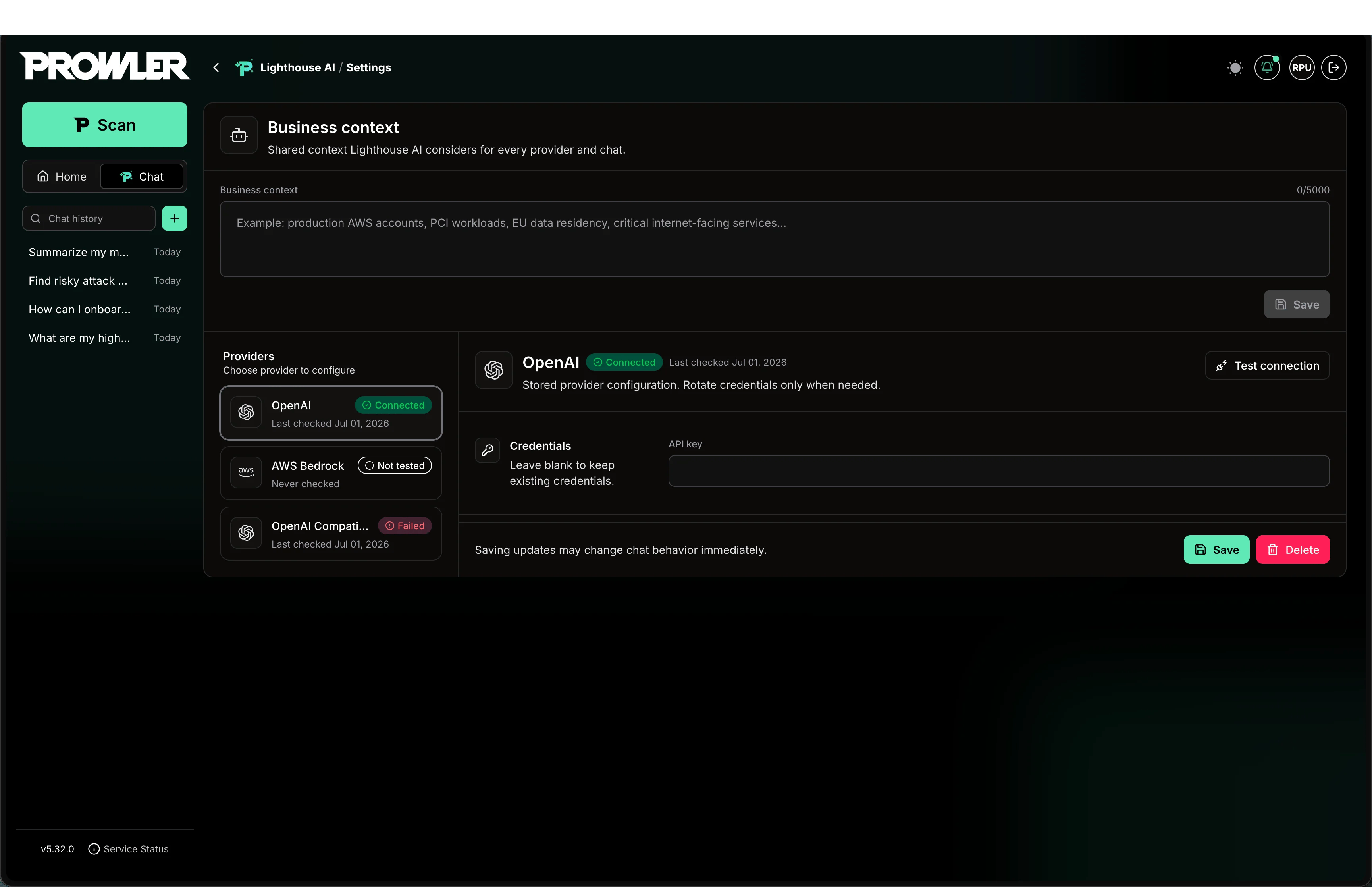
🤖 Lighthouse AI — The Agentic Cloud Defender
This feature is available exclusively in Prowler Cloud and Prowler Private Cloud with a subscription.
📄 Compliance PDF Reports Without Credentials
Compliance PDF reports no longer require the provider’s credentials to be present. Findings are now enriched from the provider metadata stored in the database, so a report still generates even after the provider secret has been deleted or its credentials have become invalid.Read more in the compliance documentation.⏳ Scan Queueing
Overlapping scans for the same provider now queue behind the active one instead of dispatching concurrent scan workers. Launch a manual scan while a scheduled one is running and it waits its turn. No more duplicated work or racing scans.🔐 Security
The Kubernetes provider credentials now reject kubeconfigs usingexec authentication in Prowler Cloud, at the API and in the credential form, preventing user-supplied commands from running on Cloud workers.Read more in the Kubernetes provider authentication documentation.🙌 External Contributors
Thank you to our community contributors for this release!- @kratos0718 — Azure
postgresql_flexible_server_log_retention_days_greater_3Flexible Server log retention fix (#11761) - @Sanjays2402 —
KeyError: 'MANUAL'crash fix in the compliance summary table, shipped early in v5.32.1 (#11823)
July 2, 2026
🔎 Findings Triage
This feature is available exclusively in Prowler Cloud and Prowler Private Cloud with a subscription.

FAIL to PASS on the next scan it moves to Resolved, and when it flips from PASS back to FAIL it moves to Reopened. You always know whether an issue is genuinely fixed or has regressed, without touching it by hand.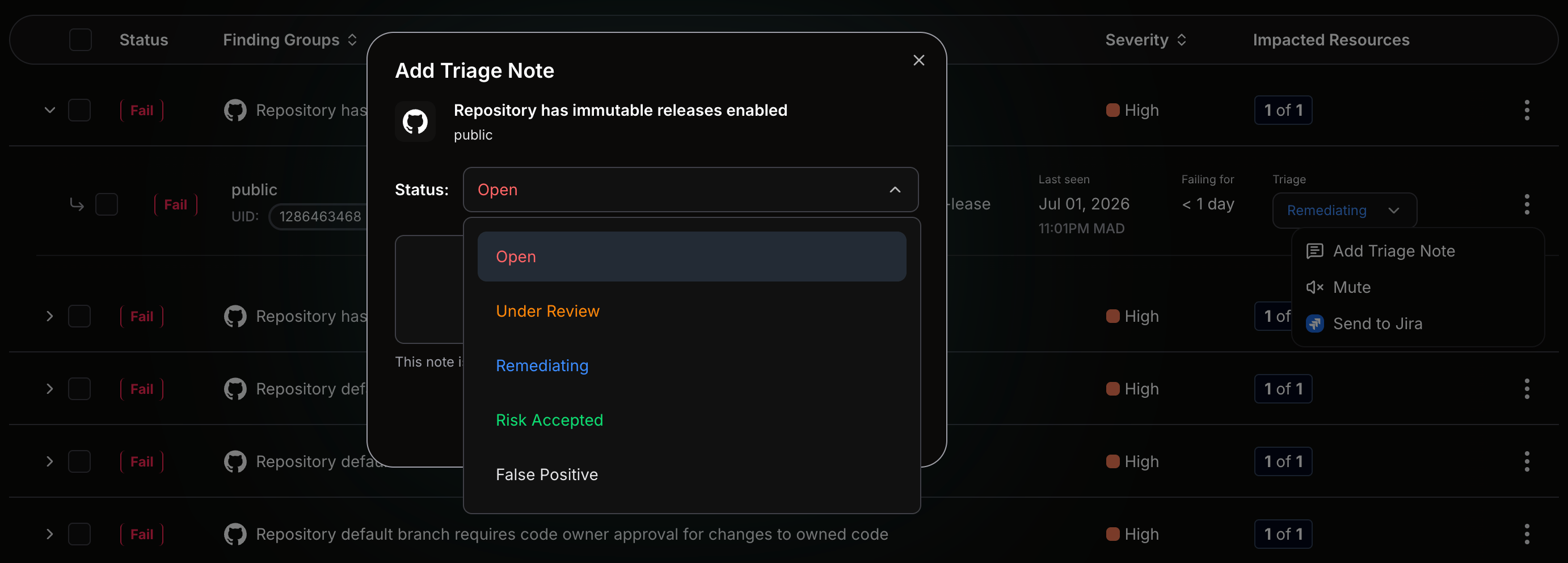
⚙️ Scan Configuration
This feature is available exclusively in Prowler Cloud and Prowler Private Cloud with a subscription.
prowler/config/config.yaml, so you only include the keys you want to override; the rest fall back to the built-in defaults. Values are validated on save against a per-provider, type-safe configuration schema that range-checks each field and rejects unknown keys, so a malformed config is caught before it ever reaches a scan. Attach a configuration to one or more providers so it applies on their next scan, or save it now and attach providers later.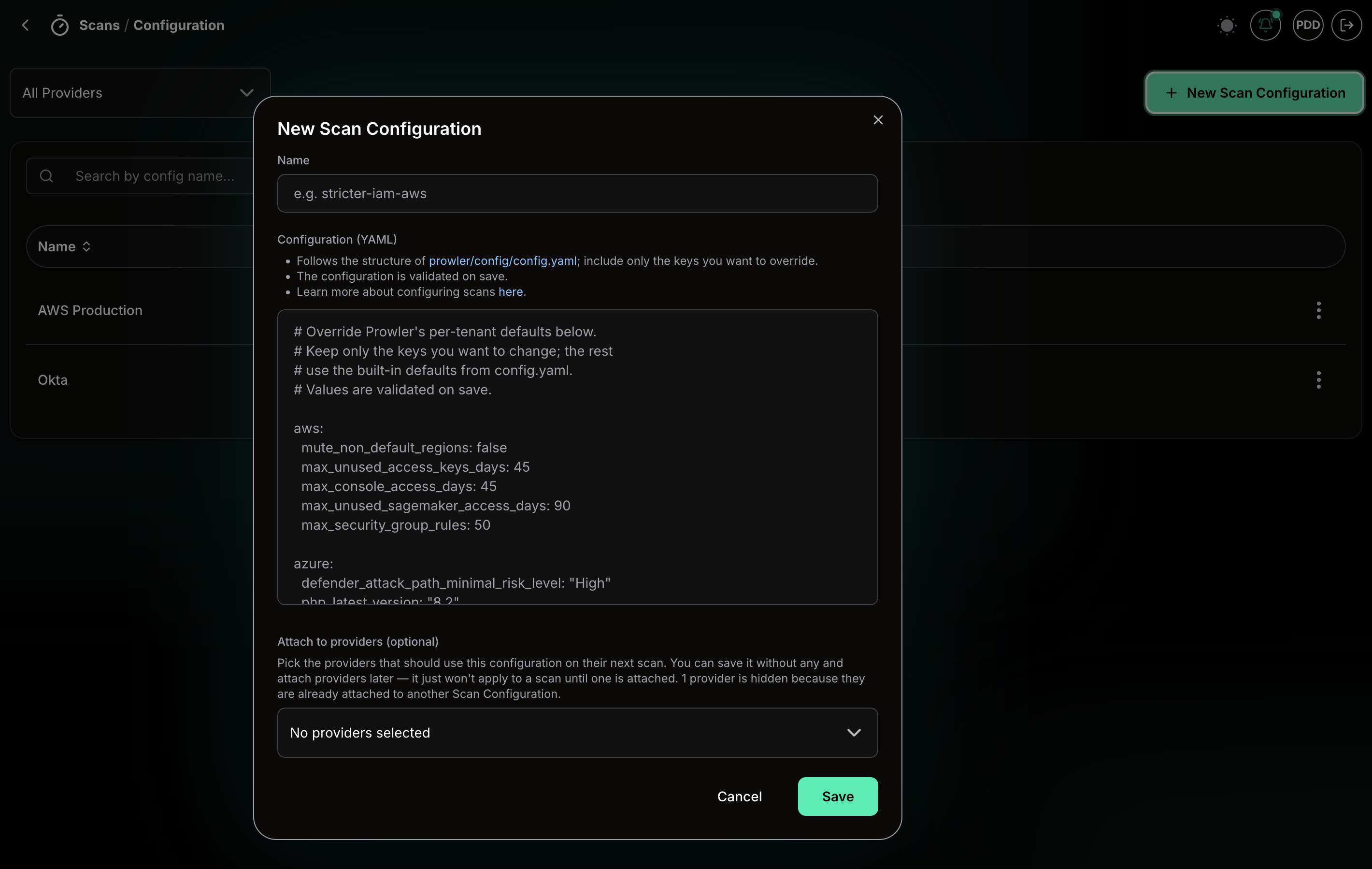
Default or any of your saved ones) without leaving the page. No more passing config files around by hand.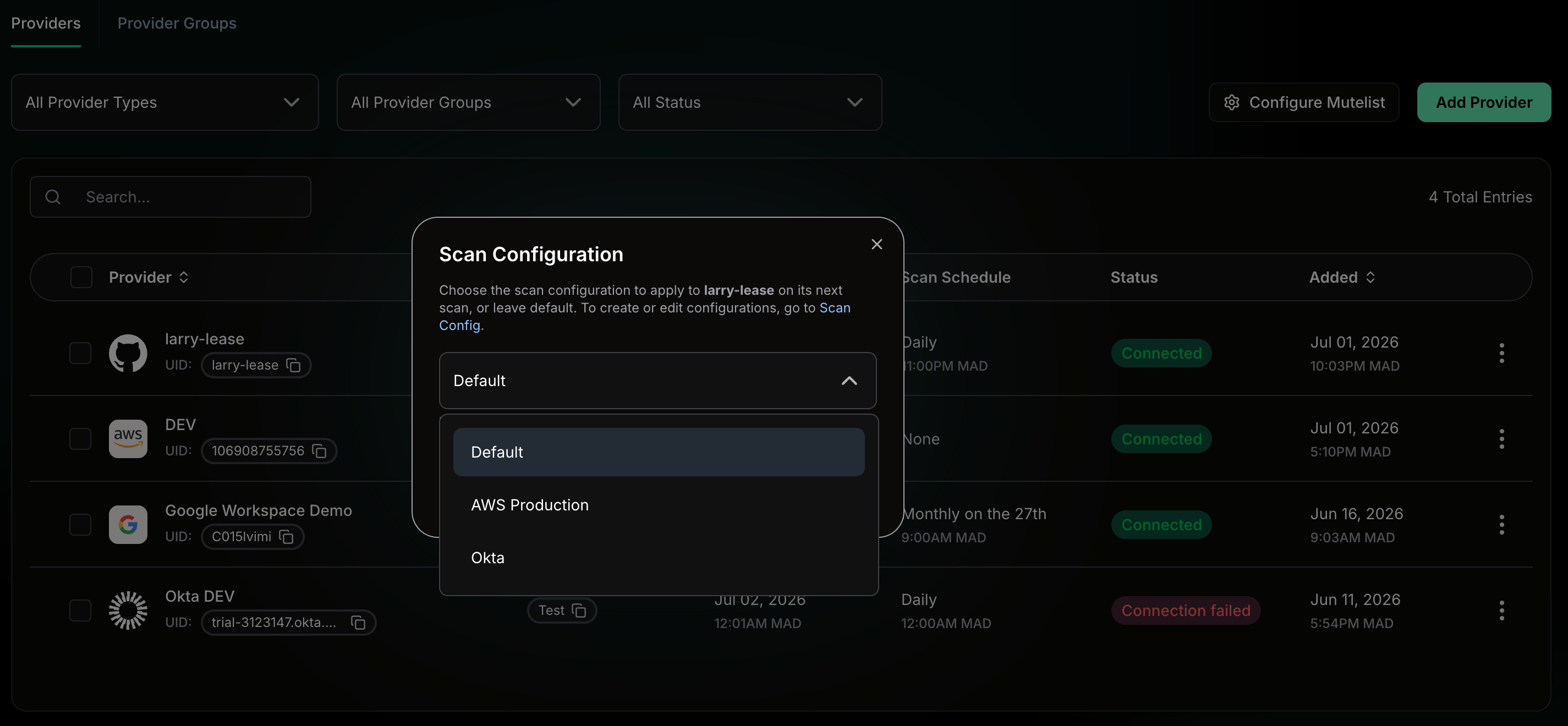
✅ Per-Requirement Configuration Validation
This feature is available exclusively in Prowler Cloud and Prowler Private Cloud with a subscription.
ConfigRequirements on a requirement, so it’s reported as FAIL when its mapped checks ran under a configuration too loose to satisfy it. Even if every individual finding PASSed. This applies across all compliance outputs: CSV, OCSF, and console tables, and is the engine behind Scan Configuration’s “marked as FAIL” behavior described above.
⏱️ Okta — Request Throttling & Retries
Prowler now proactively throttles Okta API requests to stay under rate limits, with reactive retries on HTTP 429 as a safety net. Both are set in the scan configuration (or their equivalent CLI flags):okta_requests_per_second(config file) /--okta-requests-per-second(CLI) — cap the request rate. Default: 4 req/s.okta_max_retries(config file) /--okta-retries-max-attempts(CLI) — bound retry attempts. Default: 5.
📉 AWS — Cap Resources Scanned per Service
Large AWS accounts can now cap how many resources Prowler analyzes for the highest-volume services, keeping scan time and cost under control. Set a global limit withmax_scanned_resources_per_service, or override it per service:- EBS snapshots (
max_ebs_snapshots) - Backup recovery points (
max_backup_recovery_points) - CloudWatch log groups (
max_cloudwatch_log_groups) - Lambda functions (
max_lambda_functions) - ECS task definitions (
max_ecs_task_definitions) - CodeArtifact packages (
max_codeartifact_packages)
0 = unlimited); only positive values cap the analyzed resources.Read more in the configuration file documentation.🏷️ Azure — Filter by Resource Group
Azure scans can now be scoped to one or more resource groups with the new--azure-resource-group / --azure-resource-groups option. This lets you run focused assessments against specific environments, teams, or workloads instead of scanning every accessible resource in the subscription. Thanks to @Legin-ML for contributing this feature!🧭 Provider Group Filter
Filter the Overview, Findings, Resources, Scans, and Providers views by provider group. Scope the whole app to a team, an environment, or a business unit in one click instead of filtering provider by provider.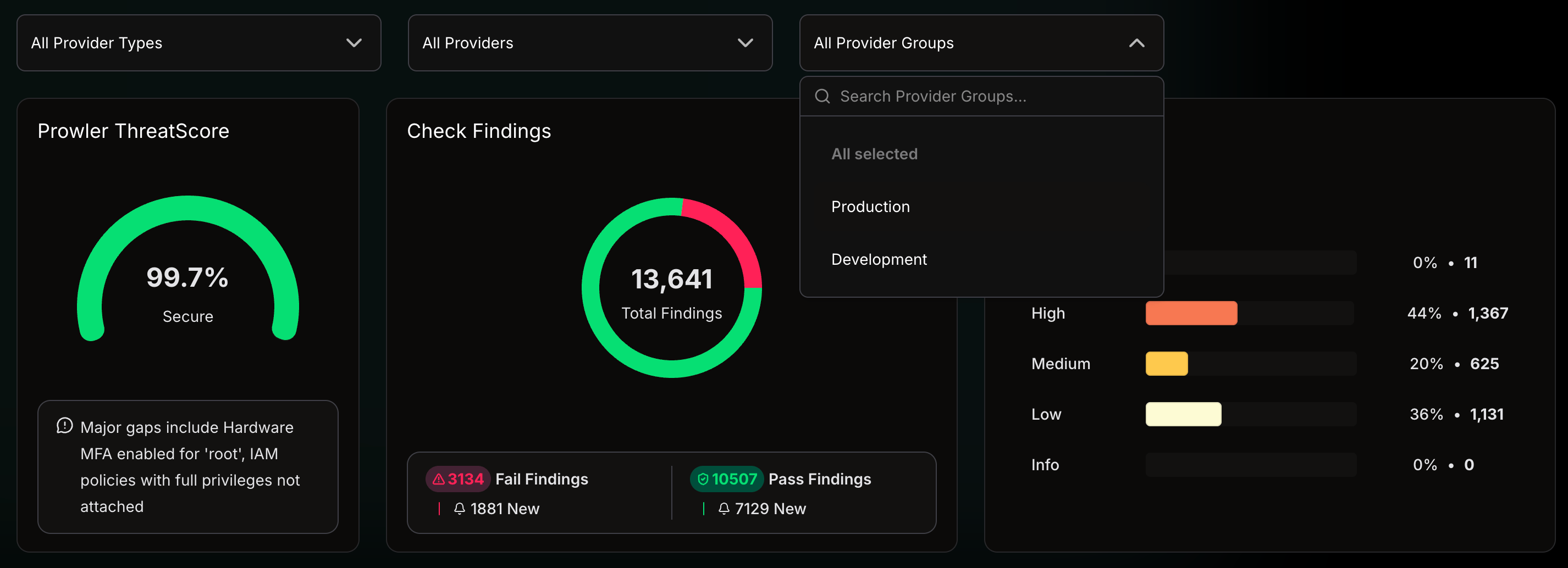
🔬 API — Timestamp Precision in Findings Filters
The/api/v1/findings endpoint now accepts full timestamps on the inserted_at and updated_at filters (filter[inserted_at__gte], filter[inserted_at__lte], and the updated_at variants), so you can query narrow time windows instead of whole days. Date-only filtering keeps working, so existing integrations are unaffected.🕸️ Attack Paths — Neptune as a persistent sink
Attack Paths can now persist its graph in AWS Neptune in addition to Neo4j, selectable viaATTACK_PATHS_SINK_DATABASE=neptune (default neo4j). Cartography’s per-scan ingest database stays on Neo4j. The scan task preflights the ingest database and the configured sink before ingestion, and provider graph cleanup now deletes relationships in directed batches before deleting nodes.This is the groundwork for scale: a managed graph database lets Attack Paths hold much larger graphs, extend coverage to more providers, and link resources across them so an attack path can cross provider boundaries instead of stopping at one cloud’s edge.Read more in the Attack Paths documentation.🔐 New Secret-Scanning Engine — Kingfisher
Prowler’s secret-scanning checks now run on Kingfisher instead ofdetect-secrets. Scans run fully offline by default, and obvious placeholder values (e.g. password123, changeme) are no longer reported, cutting down false positives.Opt in to live validation with the new --scan-secrets-validate flag (or the aws.secrets_validate config option): Prowler checks discovered secrets against the provider APIs, and any secret confirmed to be live is reported as critical, so you can prioritize the credentials that actually work.The
detect_secrets_plugins configuration option has been removed, as it is no longer used by the new engine.🔍 Checks
AWS
stepfunctions_statemachine_encrypted_with_cmk— Step Functions state machines use a customer-managed KMS key for encryption at rest instead of the default AWS-owned key. Thanks to @Sid-0602!waf_regional_webacl_logging_enabled— AWS WAF Classic Regional Web ACLs have logging enabled to a Kinesis Data Firehose stream. Thanks to @Sid-0602!- IAM privilege escalation — the privesc checks now cover AWS Bedrock AgentCore paths across Runtime, Harness, Code Interpreter, and Custom Browser. Thanks to @MrCloudSec!
apigateway_restapi_no_secrets_in_stage_variables— scans API Gateway REST API stage variables for hardcoded passwords, API keys, and tokens. Thanks to @chirag1206!awslambda_function_no_secrets_in_code— this check now supports asecrets_ignore_filesaudit-config option to skip files inside the deployment package by glob pattern (e.g.*.deps.json), suppressing .NET dependency-manifest false positives without masking real secrets.s3_bucket_object_public— spot-checks a configurable sample of object ACLs in each bucket and flags objects granted to theAllUsersorAuthenticatedUsersgroups. Disabled by default; opt in via thes3_bucket_object_public_enabledconfiguration option. Thanks to @Synchx00!
Microsoft 365
New Conditional Access hardening checks:entra_conditional_access_policy_explicitly_targets_azure_devops— at least one enabled policy explicitly includes the Azure DevOps cloud application, rather than relying on a broad “All cloud apps” policy. Thanks to @mzl2233!entra_conditional_access_policy_no_exclusion_gaps— every user, group, role, or application excluded from an enabled policy stays in scope of another enabled policy. Thanks to @UTKARSH698 with @arieleli01212 as co-author!entra_conditional_access_policy_groups_management_restricted— every security group referenced by an enabled or report-only policy is management-restricted or role-assignable. Thanks to @SAMurai-16!exchange_application_access_policy_restricts_mailbox_apps— every service principal with Microsoft Graph application-level Exchange mailbox permissions is restricted by an Exchange Online Application Access Policy. Thanks to @VasistAcharya!
📚 Compliance
CIS Benchmark Refresh — Six New Versions
Prowler ships a coordinated refresh of the CIS Benchmarks across six providers:- AWS — CIS Amazon Web Services Foundations Benchmark v7.0.0, adding the new Organizations section (2.1.1-2.1.6), resource policy (2.21), web front-end access logging (4.10), and VPC Endpoints (6.8) recommendations.
- Azure — CIS Microsoft Azure Foundations Benchmark v6.0.0.
- GCP — CIS Google Cloud Platform Foundation Benchmark v5.0.0.
- Kubernetes — CIS Kubernetes Benchmark v2.0.1.
- GitHub — CIS GitHub Benchmark v1.2.0.
- Microsoft 365 — CIS Microsoft 365 Foundations Benchmark v7.0.0.
CIS Controls v8.1 — Universal Framework
A new universal (cross-provider) compliance framework mapping existing checks across 18 providers — AWS, Azure, GCP, Kubernetes, M365, GitHub, AlibabaCloud, OracleCloud, GoogleWorkspace, Okta, Cloudflare, Vercel, MongoDB Atlas, OpenStack, Linode, StackIT, NHN, and Scaleway — to the 18 CIS Critical Security Controls and their Safeguards. Ships with a dedicated detail view and report mapping in the UI.Read more in the compliance documentation. Explore the full compliance catalog at Prowler Hub.🙌 External Contributors
Thank you to our community contributors for this release!- @chirag1206 —
apigateway_restapi_no_secrets_in_stage_variablescheck (#11188) - @MrCloudSec — AWS Bedrock AgentCore privilege escalation paths in the IAM privesc checks (#11726)
- @Sid-0602 —
stepfunctions_statemachine_encrypted_with_cmk(#11538) andwaf_regional_webacl_logging_enabled(#11539) checks - @mzl2233 —
entra_conditional_access_policy_explicitly_targets_azure_devopscheck (#11182) - @UTKARSH698 with @arieleli01212 as co-author —
entra_conditional_access_policy_no_exclusion_gapscheck (#11577) - @SAMurai-16 —
entra_conditional_access_policy_groups_management_restrictedcheck (#11342) - @vahidg — Azure PostgreSQL flexible server collection resilience fix (#11595)
- @davletd — Azure
keyvault_logging_enabledAuditEventcategory fix (#11660) - @VasistAcharya —
exchange_application_access_policy_restricts_mailbox_apps(#11247) - @Legin-ML — Filter scans at Resource Group level (#10657)
- @Synchx00 —
s3_bucket_object_publiccheck (#9517)
June 23, 2026
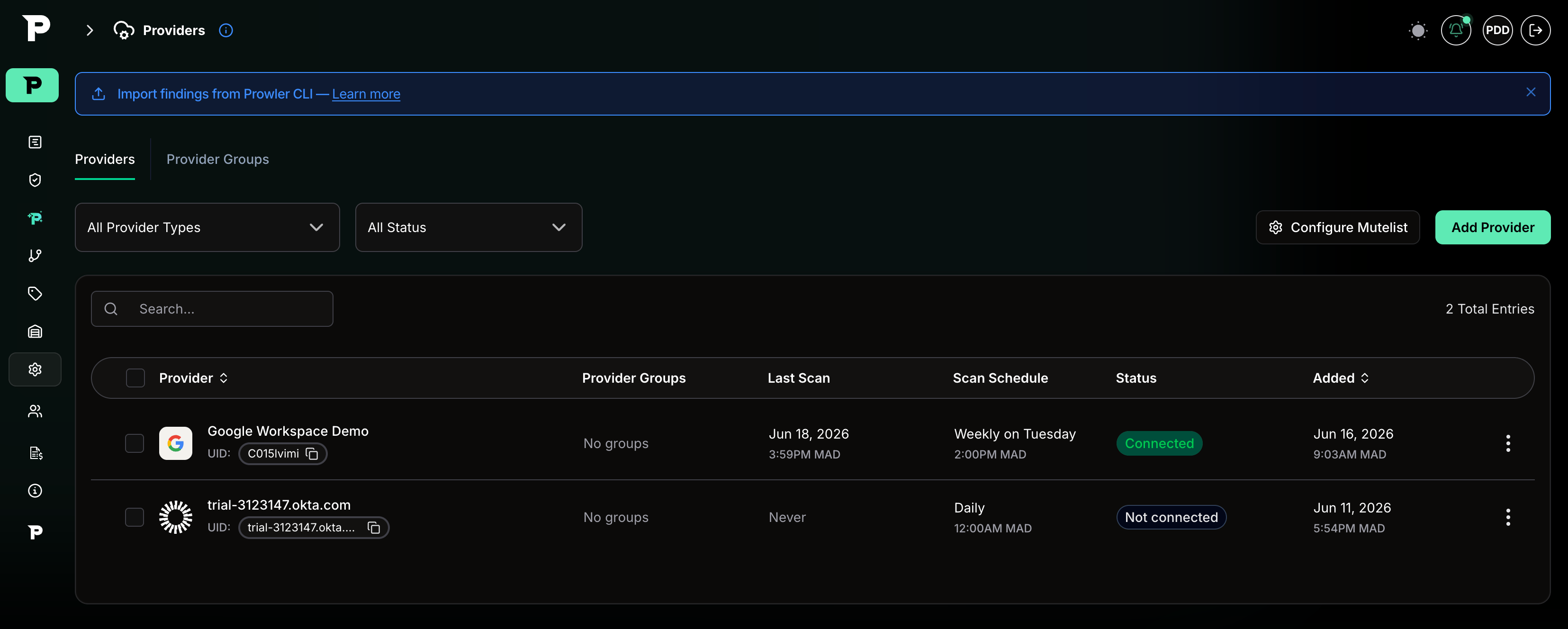
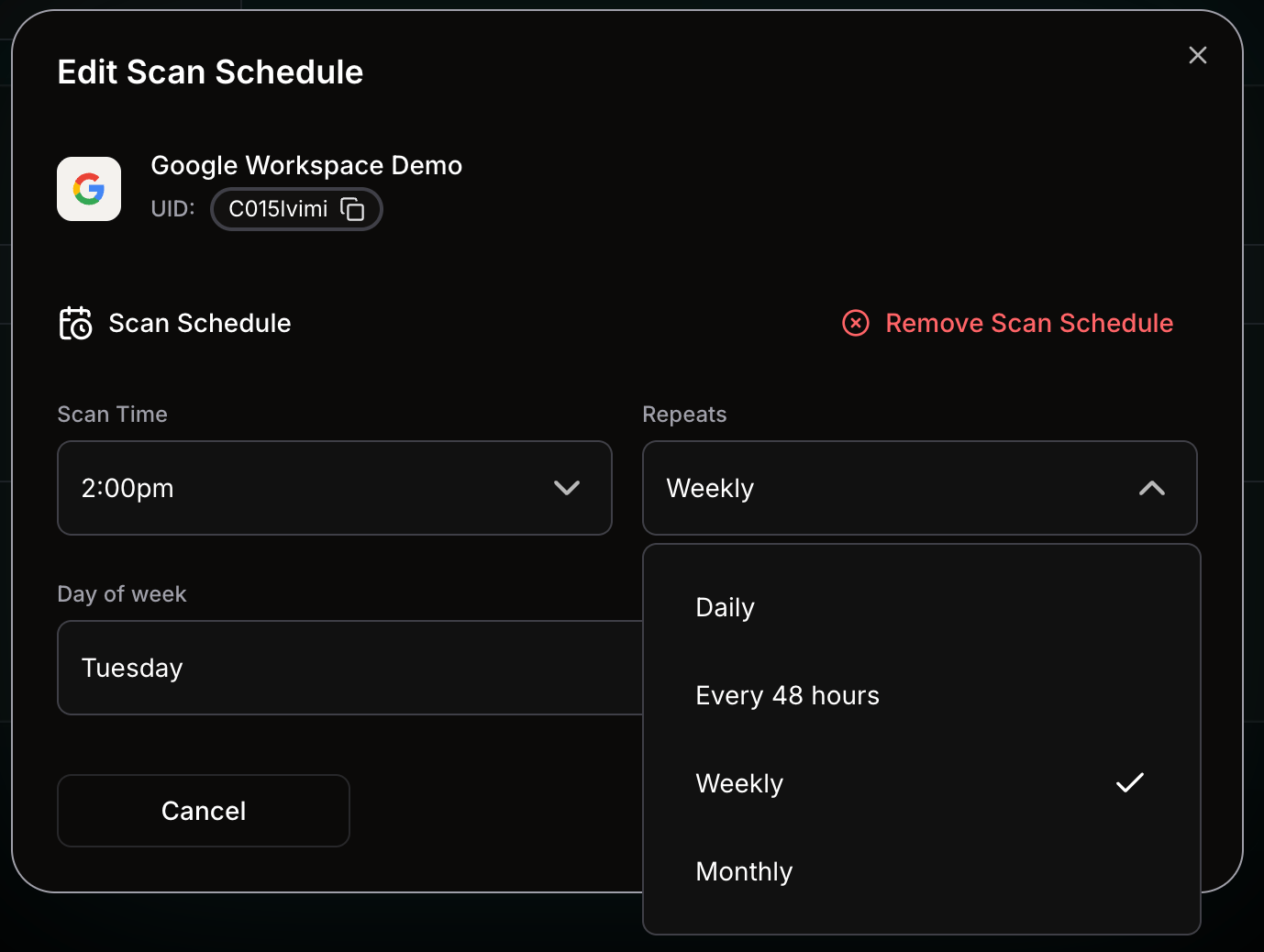
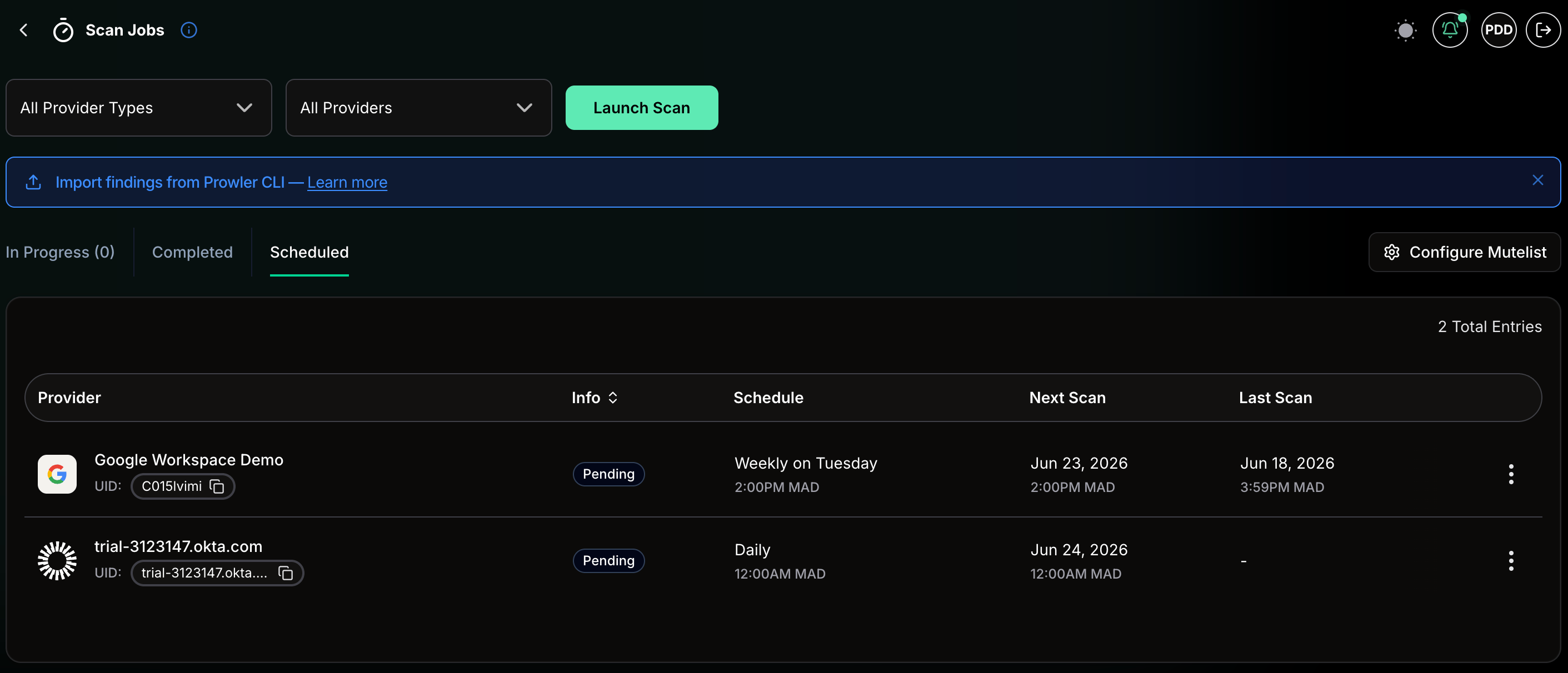
🗓️ Flexible Scan Scheduling
Available exclusively in Prowler Cloud. Prowler Local Server supports daily scans only.
📚 DORA — Expanded Provider Coverage
Prowler extends DORA (Digital Operational Resilience Act, Regulation (EU) 2022/2554) coverage to Azure, GCP, Cloudflare, and Alibaba Cloud, mapping each provider’s existing checks across the five DORA pillars.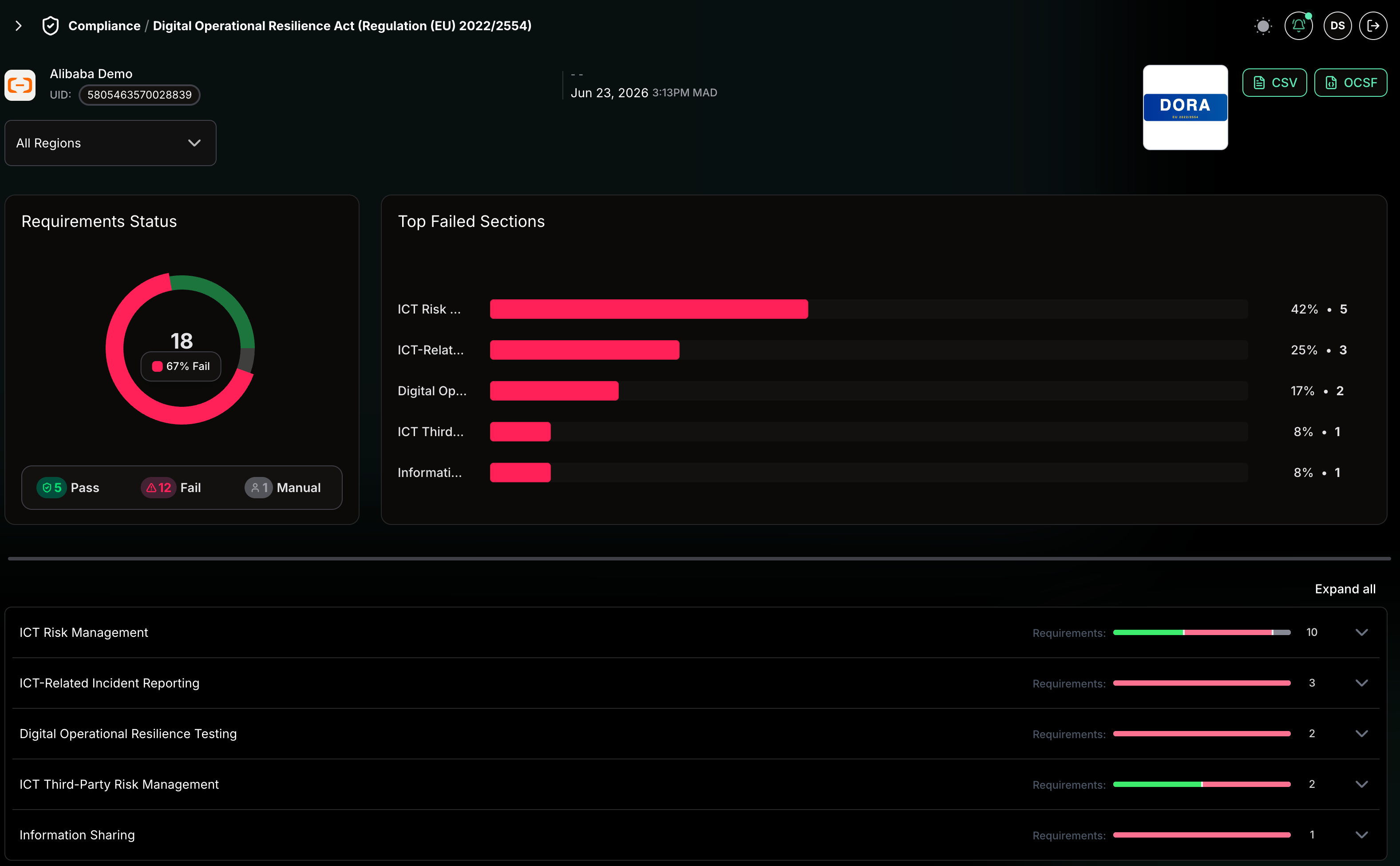
The framework follows the
<name>_<version> naming convention as DORA_2022_2554.🚀 Guided Onboarding
Available exclusively in Prowler Cloud.

🔐 Optional SAML SSO userType
The SAML userType attribute is now optional. If your IdP does not send it, or sends it blank, Prowler keeps the user’s existing roles unchanged instead of replacing them with a fallback role.When userType is provided, Prowler still maps the user to the matching role. If that role does not exist yet, Prowler creates it with read-only access: visibility over all providers, with no management permissions.Read more in the SAML SSO documentation.🏢 New Provider — Linode
Prowler now scans Linode (Akamai Cloud), covering its administration, compute, and networking services. Thanks to @varunmamillapalli for their 1st provider in Prowler!Linode is not officially supported. For more information, contact us.
🔍 Checks
AWS
Post-Quantum Cryptography readiness — get ahead of the migration to quantum-resistant cryptography:cloudfront_distributions_pqc_tls_enabled— CloudFront distributions enforce a post-quantum TLS 1.3 security policy.apigateway_domain_name_pqc_tls_enabled— API Gateway custom domain names use a post-quantum TLS security policy.transfer_server_pqc_ssh_kex_enabled— Transfer Family servers use a post-quantum hybrid SSH key exchange.acmpca_certificate_authority_pqc_key_algorithm— Private CA authorities use a post-quantum (ML-DSA) key algorithm (newacmpcaservice).rolesanywhere_trust_anchor_pqc_pki— IAM Roles Anywhere trust anchors are backed by a post-quantum (ML-DSA) PKI (newrolesanywhereservice).
securityhub_delegated_admin_enabled_all_regions— Security Hub has a delegated administrator, active in all opted-in regions, with organization auto-enable on. Thanks to @ernestprovo23!config_delegated_admin_and_org_aggregator_all_regions— AWS Config has a delegated administrator and an organization aggregator covering all regions. Thanks to @ernestprovo23!
sagemaker_clarify_exists— verifies at least one SageMaker Clarify processing job exists per scanned region, so bias-detection and model-explainability controls are in place. Thanks to @AlexanderSanin!
Azure
A large batch of new Azure checks spanning data, compute, identity, and networking:- Cosmos DB — automatic failover, continuous backup policy, minimum TLS 1.2, and public network access disabled.
- MySQL & PostgreSQL Flexible Servers — geo-redundant backup and high availability.
- AKS — auto-upgrade, Azure Monitor (Container Insights), local accounts disabled, and Microsoft Defender enabled.
- Databricks — public network access disabled and secure cluster connectivity (no public IP).
- Defender — CSPM on the Standard tier.
- Networking — NSG association on subnets and DDoS Network Protection on VNets.
- Entra ID — app registration credential expiry, users with recent sign-in and strong authentication enforcement.
- Recovery Services — vaults with at least one protected backup item and vaults with adequate backup policy.
GCP
New coverage for high availability and public-exposure detection:cloudsql_instance_high_availability_enabled— Cloud SQL primary instances useREGIONALavailability for automatic zone failover.cloudfunction_function_inside_vpc— Cloud Functions use a Serverless VPC Access connector for private egress.cloudfunction_function_not_publicly_accessible— detectsallUsers/allAuthenticatedUsersIAM invocation bindings.secretmanager_secret_not_publicly_accessible— detects Secret Manager secrets with public IAM bindings.secretmanager_secret_rotation_enabled— verifies Secret Manager secrets have automatic rotation configured with a period of 90 days or less and no missed rotation.
Kubernetes
New core checks for container resource governance and reliability: CPU limits, CPU requests, memory limits, memory requests, fixed image tags, liveness probes, and readiness probes. Thanks to @Nikhilkumar2311 for all these contributions!Microsoft 365
entra_directory_sync_object_takeover_blocked— hybrid Entra tenants block cloud object takeover through soft-match and hard-match directory synchronization. Thanks to @PrettyFox0 and @omobolajiadeyan!entra_conditional_access_policy_no_deleted_object_references— flags Conditional Access policies that reference user, group, or role objects that no longer resolve in the directory. Thanks to @ernestprovo23!
Oracle Cloud Infrastructure
identity_storage_service_level_admins_scoped— CIS 3.1 control 1.15, ensuring storage service-level administrators exclude delete permissions.
🐍 Python 3.13 Support
The Prowler SDK now supports Python 3.13. Thanks to @branchv!🔐 Security Updates
- SDK —
pytest8.3.5 → 9.0.3,black25.1.0 → 26.3.1,microsoft-kiota-*→ 1.9.9, andaiohttp→ 3.14.0, patching known CVEs. - API —
aiohttp→ 3.14.0 andidna→ 3.15, patching known CVEs. - UI — bumped vulnerable
Next.js, React, AI SDK,postcss,hono,qs,esbuild, and Alpine OpenSSL packages;dompurify3.4.2 → 3.4.10, patching XSS sanitization bypass advisories. - Containers — base image bumped to
python:3.12.13-slim-bookworm(patcheslibgnutls30CVE-2026-33845 and CVE-2026-42010) andtrivyto 0.71.0 (patches embeddedgolang.org/x/cryptoand Go stdlib CVEs).
🙌 External Contributors
Thank you to our community contributors for this release!- @varunmamillapalli — New Linode provider: administration, compute, and networking services (#11633)
- @s1ns3nz0 — 20+ Azure & GCP checks across Cosmos DB, AKS, Databricks, Flexible Servers, Entra, networking, and GCP public-exposure
- @Nikhilkumar2311 — Kubernetes resource limits, requests, image tag, and probe checks (#11373)
- @ernestprovo23 — AWS Security Hub/Config org-wide delegated admin checks (#11259) and M365 conditional access check (#11236)
- @AlexanderSanin —
sagemaker_clarify_existscheck (#11211) - @PrettyFox0 with @omobolajiadeyan as co-author — M365 directory sync object takeover check (#11098)
- @branchv — Python 3.13 support (#9293)
- @alinealfa — GCP audit-filtered aggregated sinks fix (#11575)
- @b-abderrahmane — Configurable Celery worker concurrency (#11075)
Release notes for v5.30.0 and earlier, along with every patch release, are on GitHub Releases.