

 About Us
For the unified compliance score methodology used across frameworks, see Prowler ThreatScore.
Prowler Cloud
Review compliance posture using Prowler Cloud
Prowler CLI
Run compliance scans using Prowler CLI
Prowler Cloud and Prowler Local Server
The Compliance section in Prowler Cloud and Prowler Local Server centralizes compliance posture across every connected provider. It aggregates scan results, surfaces Prowler ThreatScore, and exposes detailed requirement-level evidence for each supported framework.Accessing the Compliance Section
To open the compliance overview, follow these steps:- Sign in to Prowler Cloud at cloud.prowler.com or to a Prowler Local Server instance.
- Select Compliance from the left navigation.
- Single Scan: Lists every framework evaluated by one completed scan of one provider. This is the experience described in the rest of this guide, and the default view in Prowler Local Server.
- Multiple Scans: Aggregates one framework across several scans at once, either across provider types (Cross-Provider Type Compliance) or across every provider of the same type (Cross-Provider Compliance).
Compliance results require at least one completed scan. If no scan has finished yet, Prowler Cloud and Prowler Local Server display a notice prompting to launch or wait for a scan to complete.
Filtering Compliance Results
The filters bar at the top of the overview controls which scan and which regions feed every card on the page.Scan Selector
The scan selector lists completed scans across all connected providers. Each entry includes the provider type, alias, and completion timestamp. Selecting a scan updates the entire page, including ThreatScore and every framework card.Region Filter
The region multi-select narrows results to one or more regions detected in the selected scan. Use it to evaluate compliance posture for a specific geography or regulatory boundary. The filter applies to:- The framework grid scores and pass/fail counts.
- The detailed requirement view inside each framework.
Region filters apply only to providers that report a region attribute (for example, AWS, Azure, and Google Cloud). Providers without regions ignore the filter.
Clearing Filters
Select Clear filters to reset both the region filter and any other applied filter to its default state. The scan selector is preserved.Reviewing the Prowler ThreatScore Card
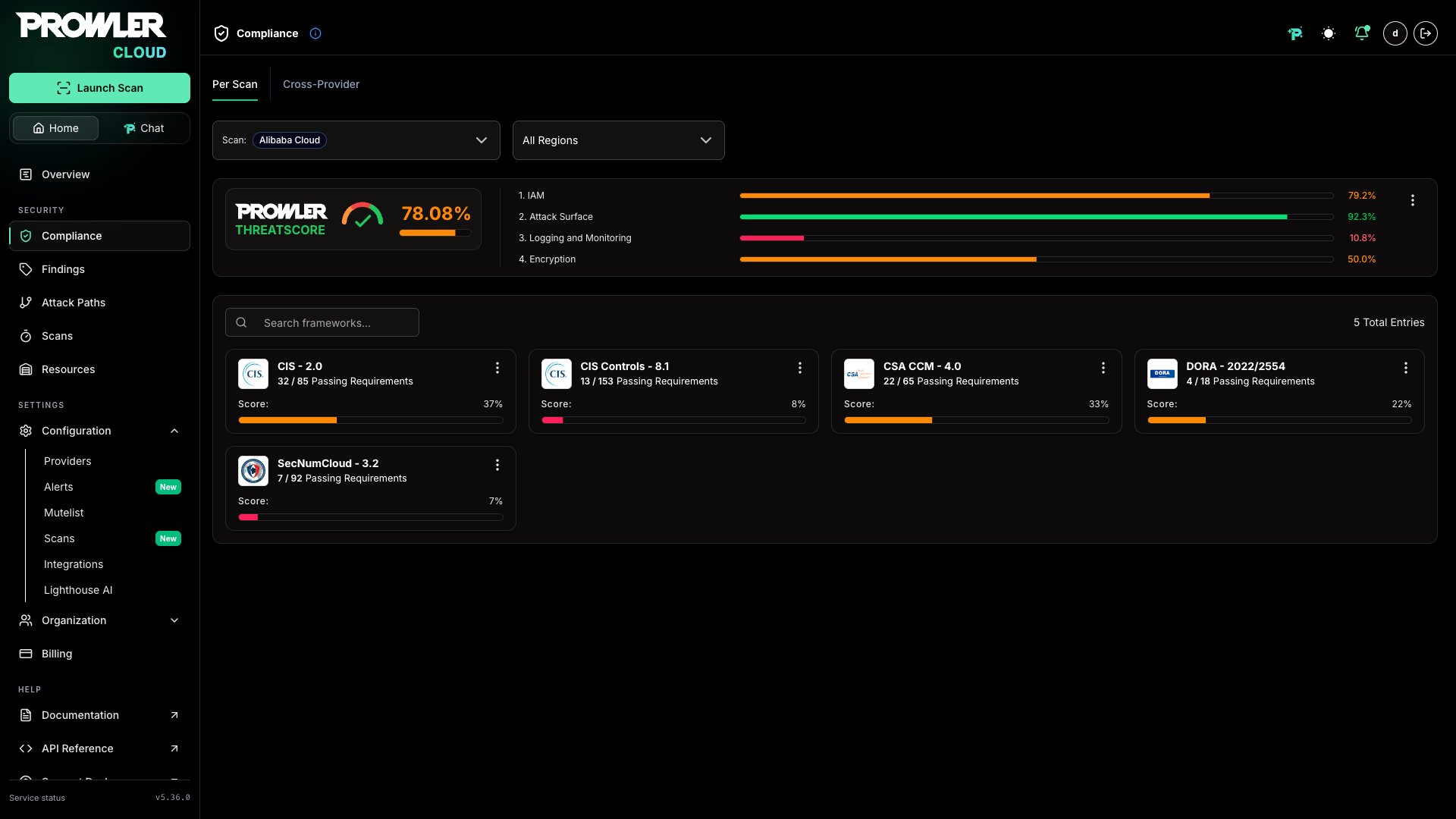
When the selected scan includes Prowler ThreatScore data, a dedicated card appears at the top of the overview, showing:- The overall ThreatScore (0–100) with a color-coded indicator.
- A progress bar reflecting current posture.
- Per-pillar bars for IAM, Attack Surface, and Logging and Monitoring.

Exploring the Framework Grid
Below ThreatScore, the framework grid shows one card per supported compliance framework. Each card includes:- Framework logo and name: Identifies the standard (CIS, NIST, ENS, ISO 27001, PCI-DSS, SOC 2, NIS2, CSA CCM, MITRE ATT&CK, and more).
- Version: Indicates the framework version applied to the scan.
- Score: The percentage of passing requirements over the total evaluated.
- Passing Requirements: A
passed / totalcounter for additional context. - Download dropdown: Quick access to the CSV report and, when supported, the PDF report.
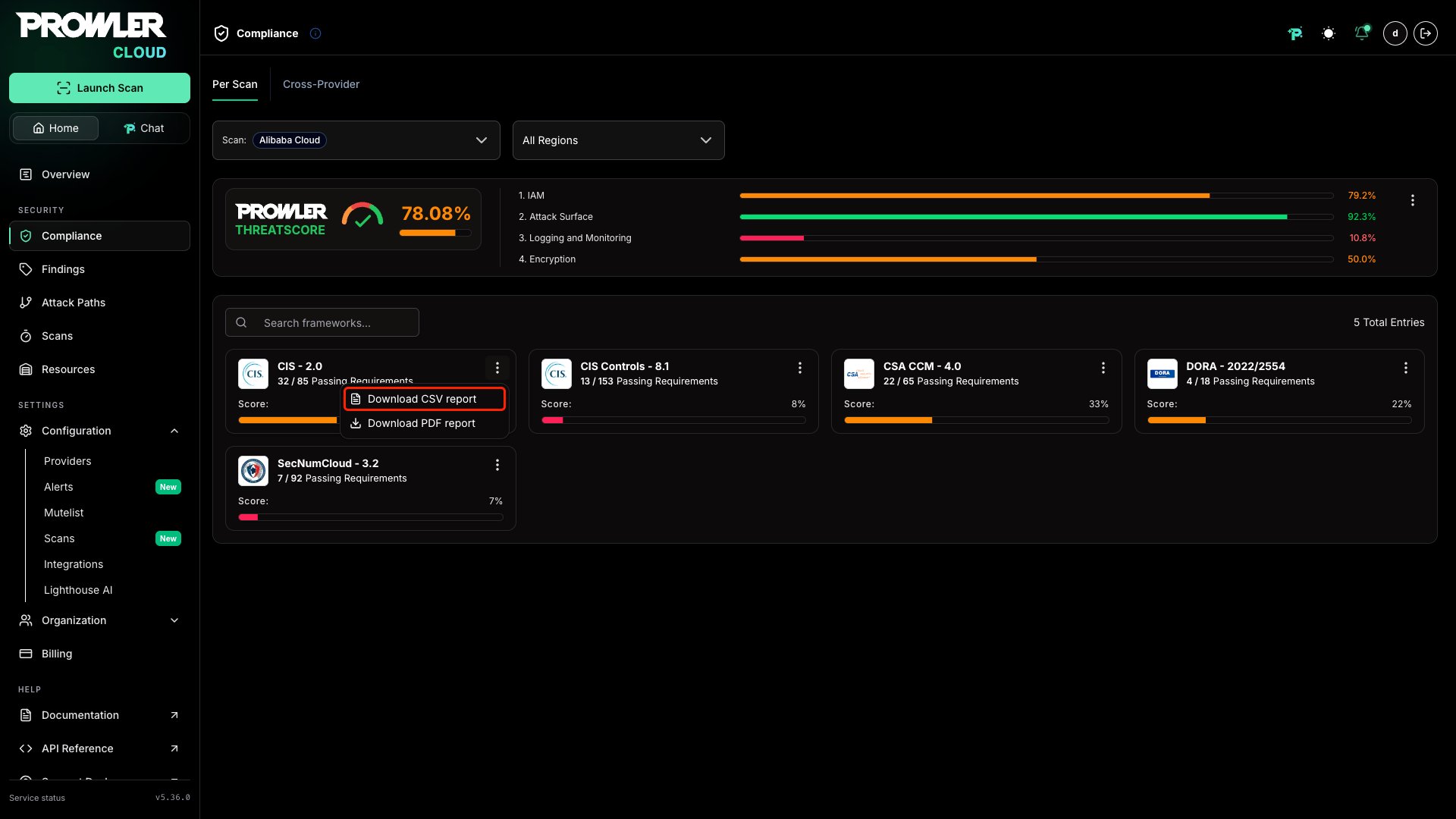
Score color coding follows three thresholds: red for severely low compliance, amber for partial compliance, and green for healthy posture. Hover over the score for the exact percentage.
Tracking Frameworks With the Compliance Watchlist
The compliance catalog lists dozens of frameworks, while an organization usually tracks a handful. In Prowler Cloud, Compliance Watchlist keeps that handful in front: pin the frameworks that matter and narrow every compliance surface down to them. The watchlist is shared by the whole organization: one list per tenant, not a per-user bookmark, so every member sees the same pinned frameworks.Pinning a Framework
Every framework card carries a pin button in its top-right corner. Select the pin to add the framework to the watchlist, and select it again to remove it. Pinning is available on the three compliance surfaces:- Single Scan: The framework grid of the selected scan.
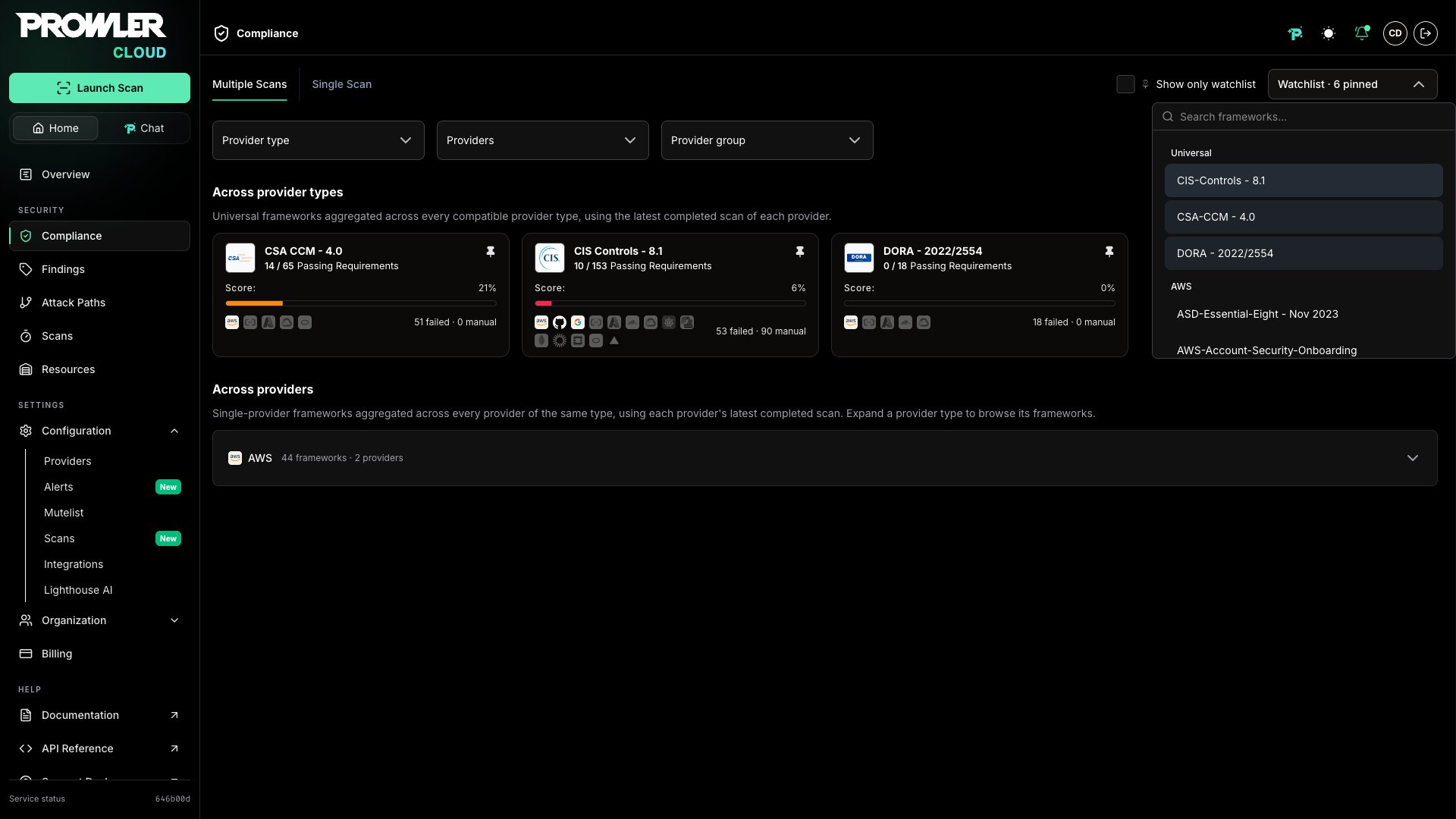
- Across provider types: The universal framework cards in the Multiple Scans tab.
- Across providers: The framework cards inside each provider type group in the Multiple Scans tab.
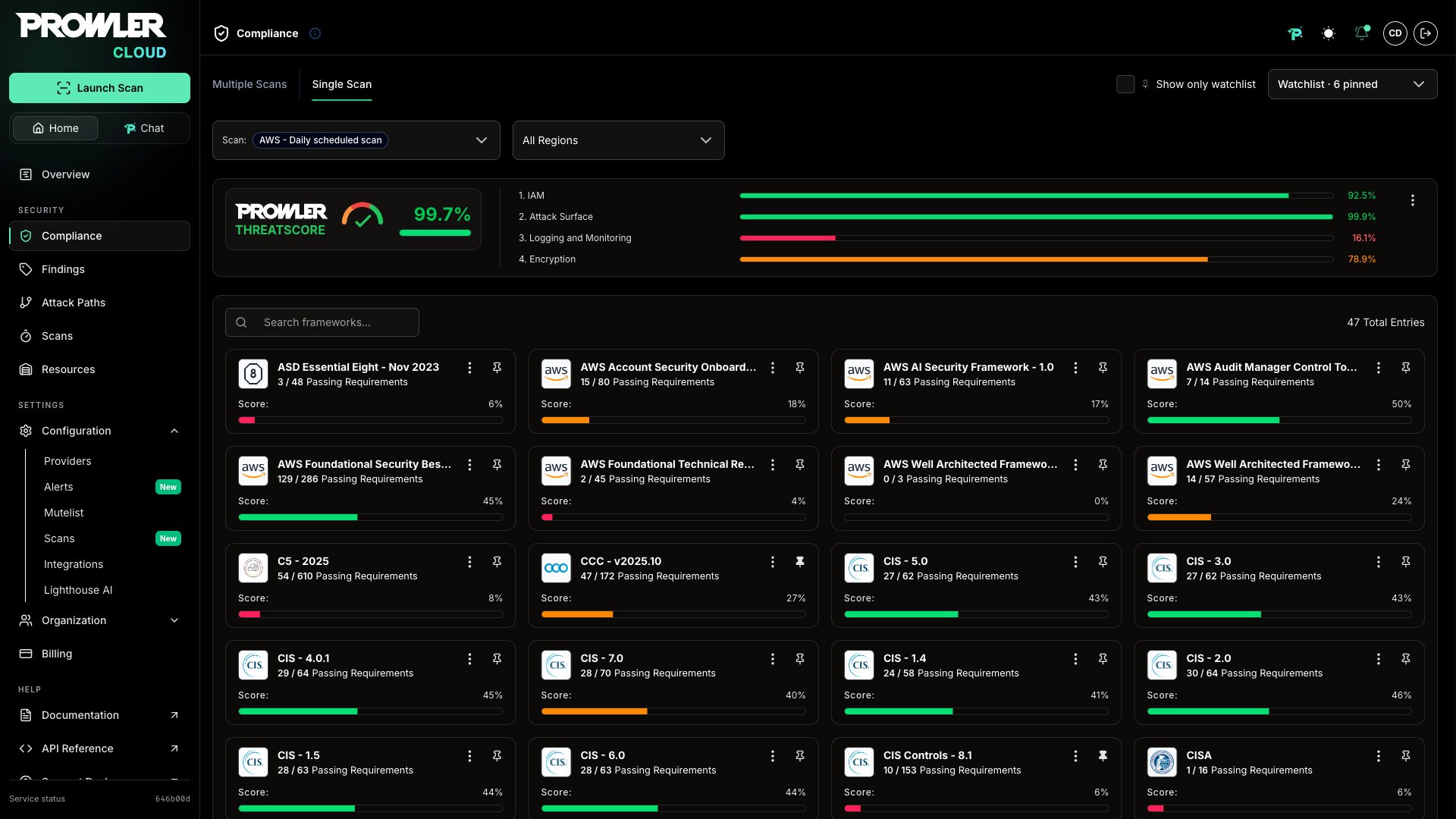
Universal frameworks (CSA CCM, CIS Controls, DORA) are a single watchlist entry. Pinning one of them from any surface shows it as pinned on the others.
Filtering With the Watchlist
Two controls sit above the tabs, because both tabs read the same watchlist:- Show only watchlist: A toggle that hides every framework not in the watchlist, on both tabs at once. When the filter leaves a section with nothing to show, the section explains that no pinned framework matches and offers to clear the filter.
- Watchlist selector: A searchable multi-select over the full framework catalog, grouped by provider. Use it to pin or unpin several frameworks in one place instead of visiting each card.
Reviewing the Watchlist on the Overview Page
The Compliance Watchlist card on the Overview page lists exactly the pinned frameworks with their current score, computed from the latest completed scan per provider. Selecting an entry opens the framework detail page. Until a framework is pinned, the card is empty and prompts to start pinning from the Compliance section.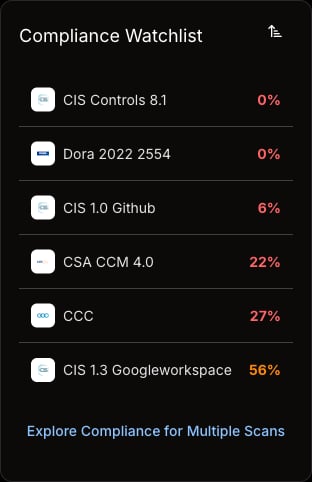
In Prowler Local Server, where the watchlist is not available, the card keeps its previous behavior and ranks every framework with scan data.
Working With the Framework Detail Page
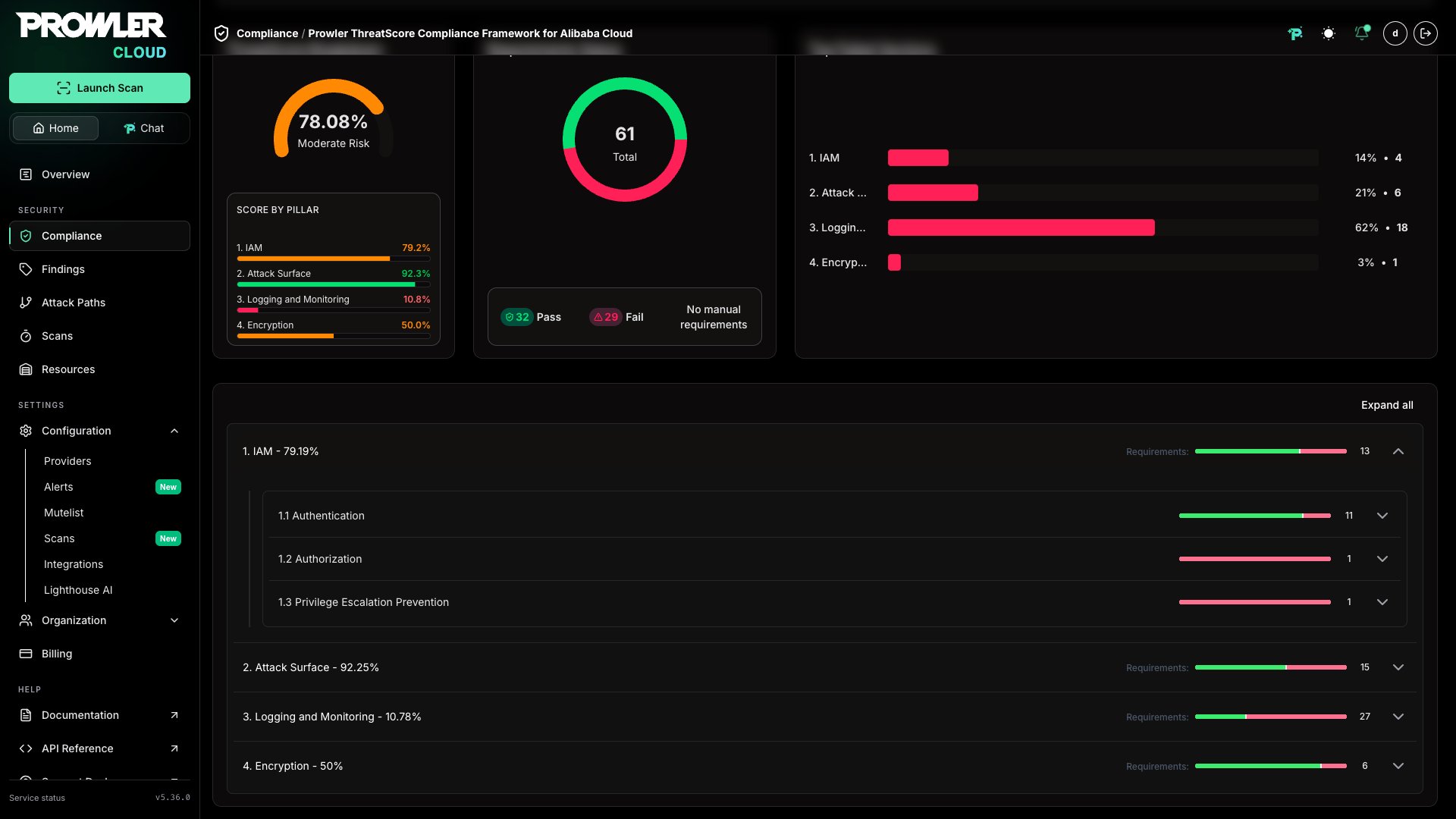
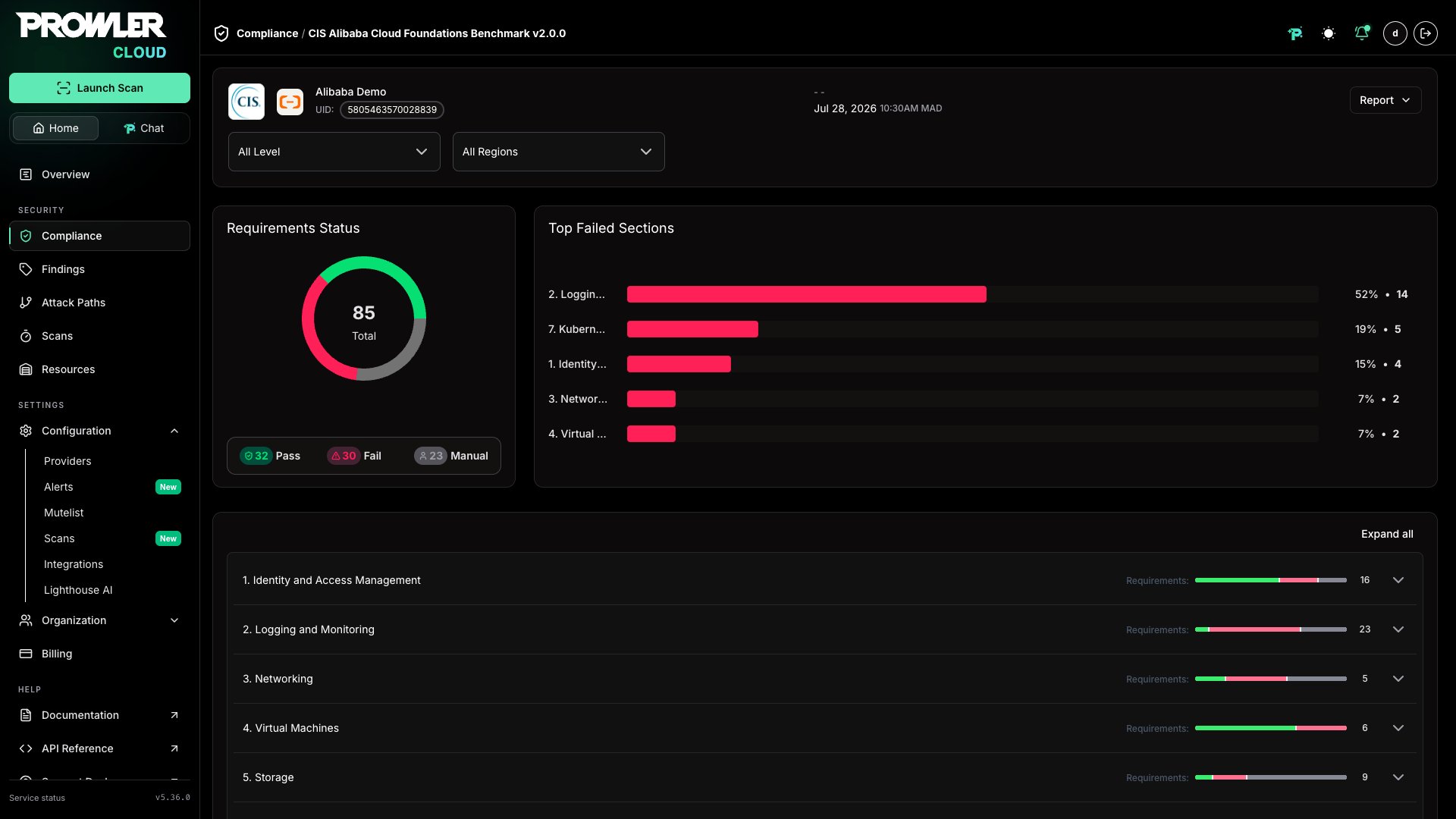
The detail page provides everything needed to evaluate a single framework: aggregate metrics, top failure sections, and a requirement-by-requirement view.Header, Summary Cards, and Download Actions
The header shows the framework name, version, the provider scan being reviewed, and CSV / PDF download buttons. Below the header, summary cards condense the framework state at a glance:- Requirements Status: Donut chart with
Pass,Fail, andManualcounts plus the total number of requirements. - Top Failed Sections: Ranks the sections or pillars with the highest number of failing requirements.
- ThreatScore Breakdown: Appears only on the ThreatScore framework. It shows the overall score and per-pillar scores aligned with the ThreatScore pillars (IAM, Attack Surface, Logging and Monitoring, Encryption).
Requirements Accordion
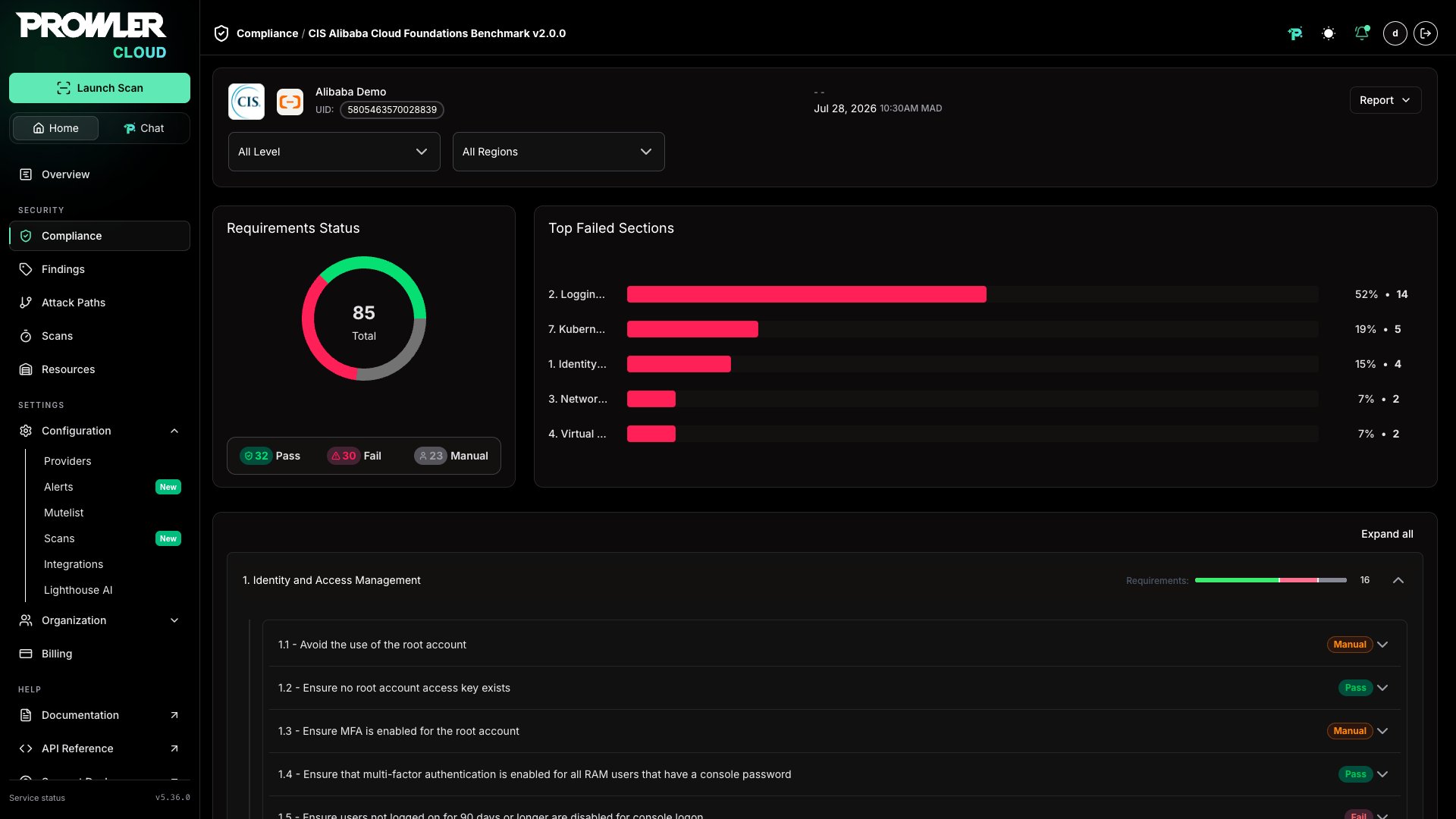
Below the summary cards, an accordion organizes every requirement of the framework. Expand a section to see:- Requirement ID and title: Reflect the official identifier from the framework.
- Pass / Fail / Manual badges: Indicate the status of each requirement based on the underlying checks.
- Custom details panel: Opens additional context tailored to the framework. For frameworks with custom layouts, the panel surfaces fields such as control objectives, severity, attack tactics, regulatory references, or required evidence.
Frameworks With Custom Detail Layouts
Several frameworks include enriched detail panels that highlight fields specific to the standard:- ASD Essential Eight
- AWS Well-Architected Framework
- BSI C5
- Cloud Controls Matrix (CSA CCM)
- CIS Benchmarks
- CCC (Common Cloud Controls)
- ENS RD2022
- ISO 27001
- KISA ISMS-P
- MITRE ATT&CK
- Prowler ThreatScore
Downloading Compliance Reports
Prowler Cloud and Prowler Local Server expose two formats:- CSV report: Every requirement, every check, and every finding for the selected scan and filters. Available for all supported frameworks.
- PDF report: Curated executive-style report. Currently supported for Prowler ThreatScore, ENS RD2022, NIS2, and CSA CCM. Additional PDF reports are added in subsequent Prowler releases.
PDF detail section is capped at the first 100 failed findings per check. The PDF is intended as an executive/auditor document, not a raw data dump: when a check produces more than 100 failed findings the report renders the first 100 and shows a banner pointing the reader to the CSV or JSON-OCSF export for the complete list. The compliance CSV and the scan outputs are never truncated.The cap is configurable per deployment via the
DJANGO_PDF_MAX_FINDINGS_PER_CHECK environment variable on the Prowler API workers; set it to 0 to disable truncation entirely. The default value of 100 keeps the PDF readable and bounded in size on enterprise-scale scans (hundreds of thousands of findings) without affecting smaller scans, where the cap is rarely reached.Only failed findings are rendered in the detail section. PASS findings for the same check are excluded at query time. The PDF surfaces what needs attention, and the CSV/JSON exports surface everything for forensic review.Downloading From the Detail Page
Inside any framework detail page, the CSV and PDF buttons in the header trigger the same downloads as the overview dropdown. The PDF button only appears for frameworks that support it.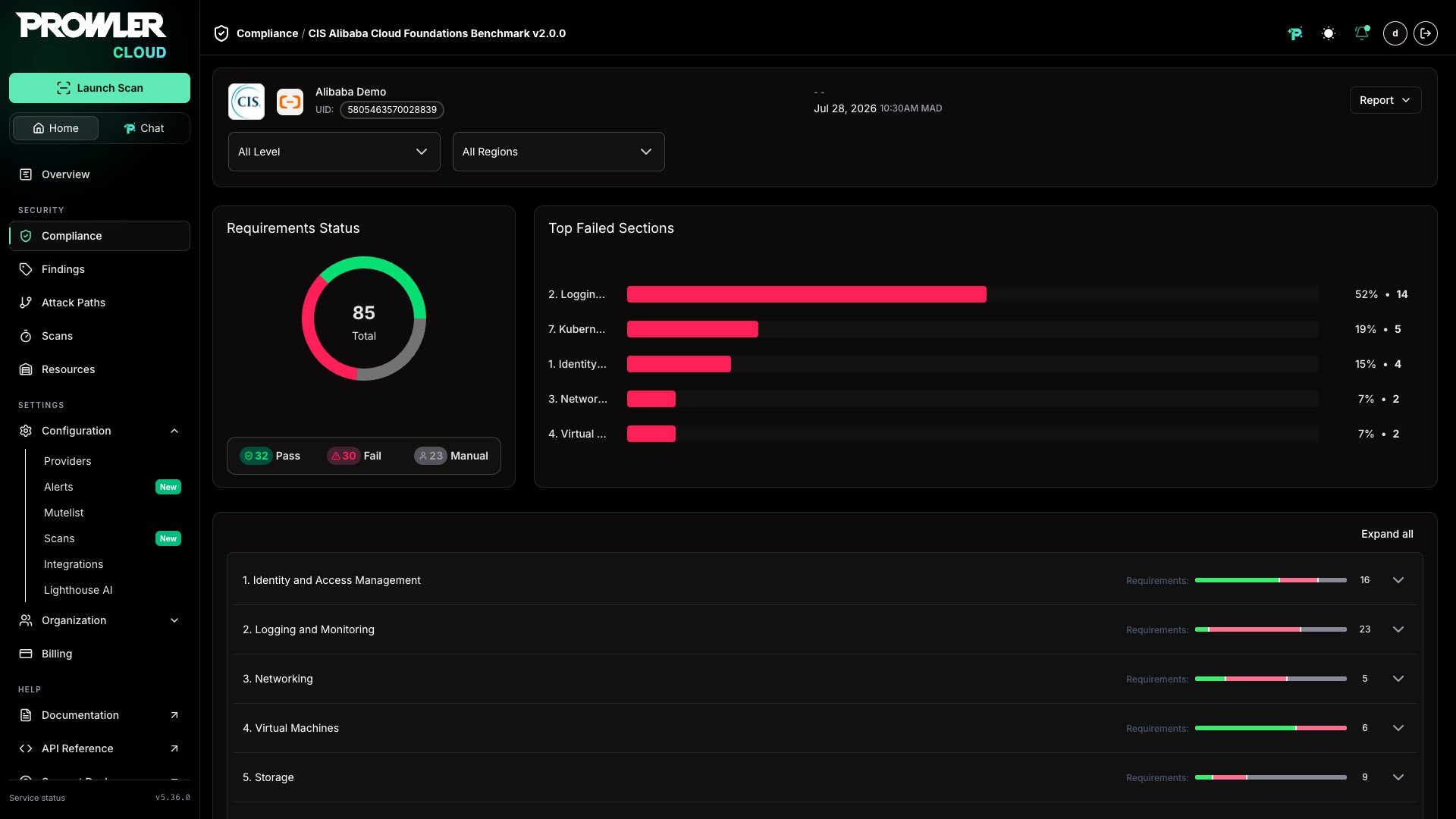
Region filters disable the per-card download dropdown to avoid generating partial reports. Open the framework detail page when downloads scoped to a region are required, or remove the region filter to download the full report.
Downloading the Full Scan Output
To export every framework, finding, and resource at once, use the Scan Jobs section instead. The ZIP archive contains the CSV, JSON-OCSF, and HTML reports plus acompliance/ subfolder with one CSV per framework. See Prowler Cloud — Getting Started for details.
API Access
Every report available in the UI is also reachable through the Prowler API. The following endpoints are the most relevant: Use the API to integrate compliance evidence into ticketing systems, executive dashboards, or downstream pipelines.Prowler CLI
Prowler CLI evaluates the same compliance frameworks as Prowler Cloud and Prowler Local Server, and produces detailed CSV outputs alongside the standard scan results. By default, it runs every supported framework and prints a status summary at the end of the scan: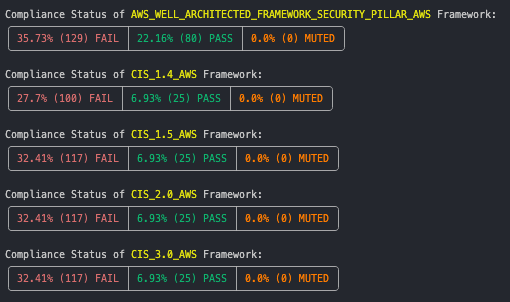
compliance/ subfolder of Prowler’s output directory.
Scan a Specific Compliance Framework
To scope a scan to a single framework and get the framework-specific summary, use the--compliance option:
compliance/ output folder. Sample output for CIS AWS 2.0:
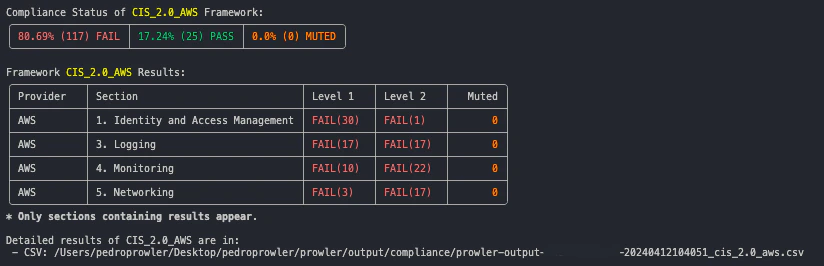
If Prowler cannot find a resource related with a check from a compliance requirement, that requirement is omitted from the output.
List Available Compliance Frameworks
To see which compliance frameworks are covered by a given provider, use the--list-compliance option:
List Requirements of a Compliance Framework
To inspect the requirements that compose a specific framework, use the--list-compliance-requirements option: